
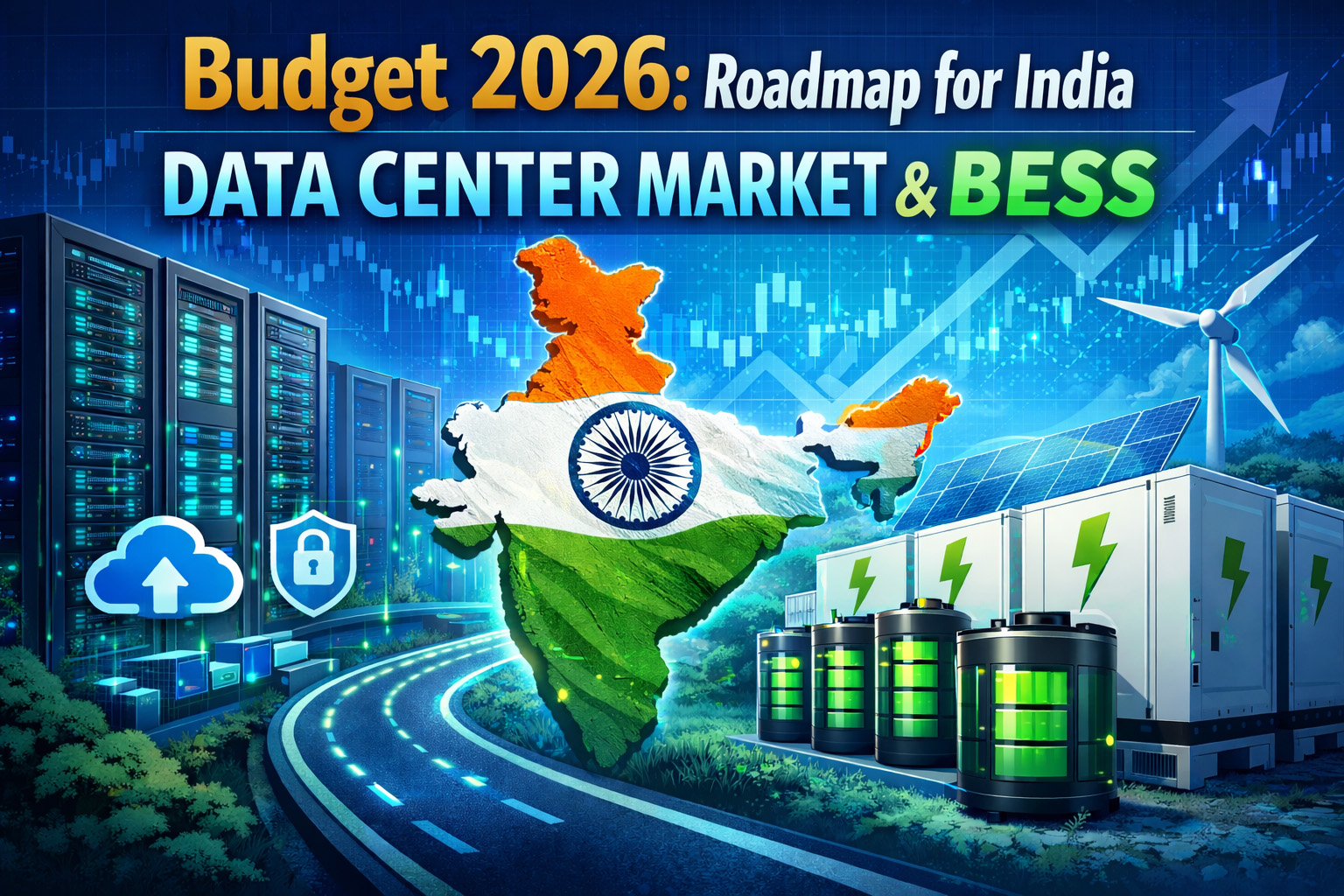
The Union Budget 2026 marks a structural shift for the India Data Center ecosystem and the broader infrastructure economy that supports it. Rather than treating digital growth as a standalone sector, the Budget integrates fiscal policy, manufacturing incentives, energy security and industrial capacity into one coordinated roadmap aligned with the vision of Viksit Bharat.
India today stands at a critical point. Data consumption is accelerating, AI workloads are expanding, enterprises are migrating to the cloud and digital public infrastructure continues to scale.
Yet the growth of the Indian data center market has been constrained by three structural pressures:
- Energy reliability
- Import dependence in manufacturing
- Capital cost predictability for global operators
Budget 2026 addresses these constraints through targeted announcements that strengthen long-term investment confidence while reinforcing domestic capability.
India Data Center: From Capacity Growth to Strategic Positioning
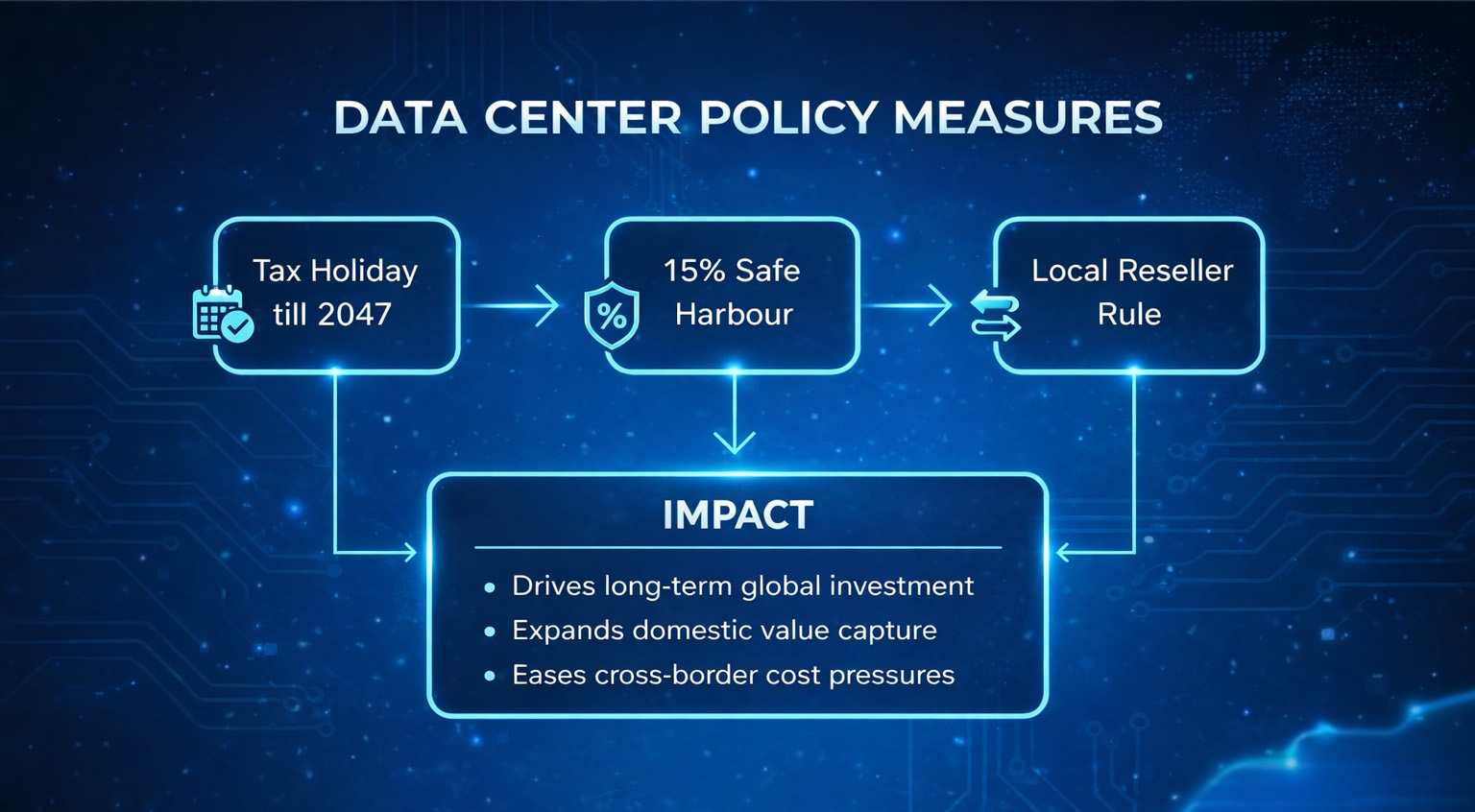
One of the most significant announcements in the Budget is the tax exemption until March 31, 2047, for certain foreign companies providing data centre services from India. This is not a short-term incentive, but a 20+ year fiscal signal.
For global cloud and infrastructure providers, long-horizon tax clarity reduces uncertainty in capital allocation decisions. Data centers are 15–25-year assets. Policy stability matters as much as demand.
Alongside this, the Budget mandates that domestic services be provided through an Indian-incorporated reseller entity, ensuring that digital transactions remain anchored within India’s taxable framework. This strengthens regulatory oversight while keeping value creation local.
Further, the proposed 15% safe harbour on costs for data centre services operated through related entities reduces transfer pricing disputes and enhances cost predictability for multinational operators.
THE IMPACT:
Together, these measures do three things:
- Encourage global players to anchor infrastructure in India
- Ensure domestic economic participation
- Reduce financial friction for cross-border operations
India’s ambition is clear: to position itself as a global hub for high-efficiency data storage, cloud services and AI-driven infrastructure. The India Data Center market is no longer just about capacity expansion; it is about strategic digital positioning.
The Energy Imperative: Why BESS Becomes Core Infrastructure
Digital infrastructure is energy infrastructure.
As rack densities increase and AI Data Centers demand higher power loads, an uninterrupted energy supply becomes non-negotiable. Grid stress, renewable intermittency and peak demand volatility create operational risks.
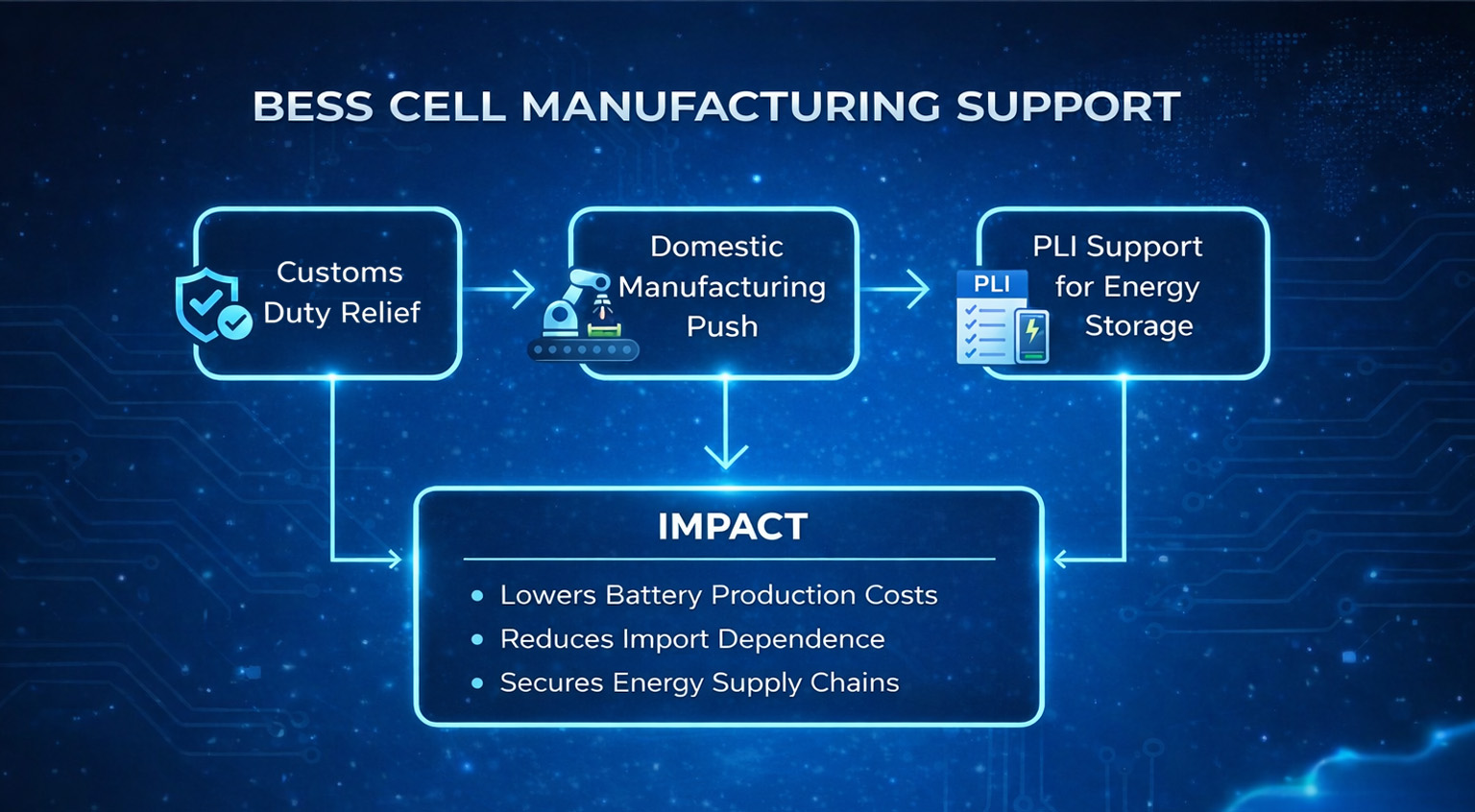
Recognizing this, Budget 2026 provides a duty exemption on capital goods for BESS cell manufacturing.
THE IMPACT:
While this may appear as a manufacturing incentive, its impact is much wider:
- It lowers capital costs for domestic battery production
- Reduces import dependency in energy storage
Strengthens supply security for mission-critical sectors
Battery Energy Storage Systems (BESS) are no longer emergency backup solutions. They are becoming structural components of digital infrastructure, enabling peak shaving, renewable integration, load balancing and uptime assurance.
For high-performing data centers, energy resilience is a competitive advantage. Budget support for BESS manufacturing directly protects digital growth from energy bottlenecks.
Container Manufacturing: Infrastructure Beyond Logistics
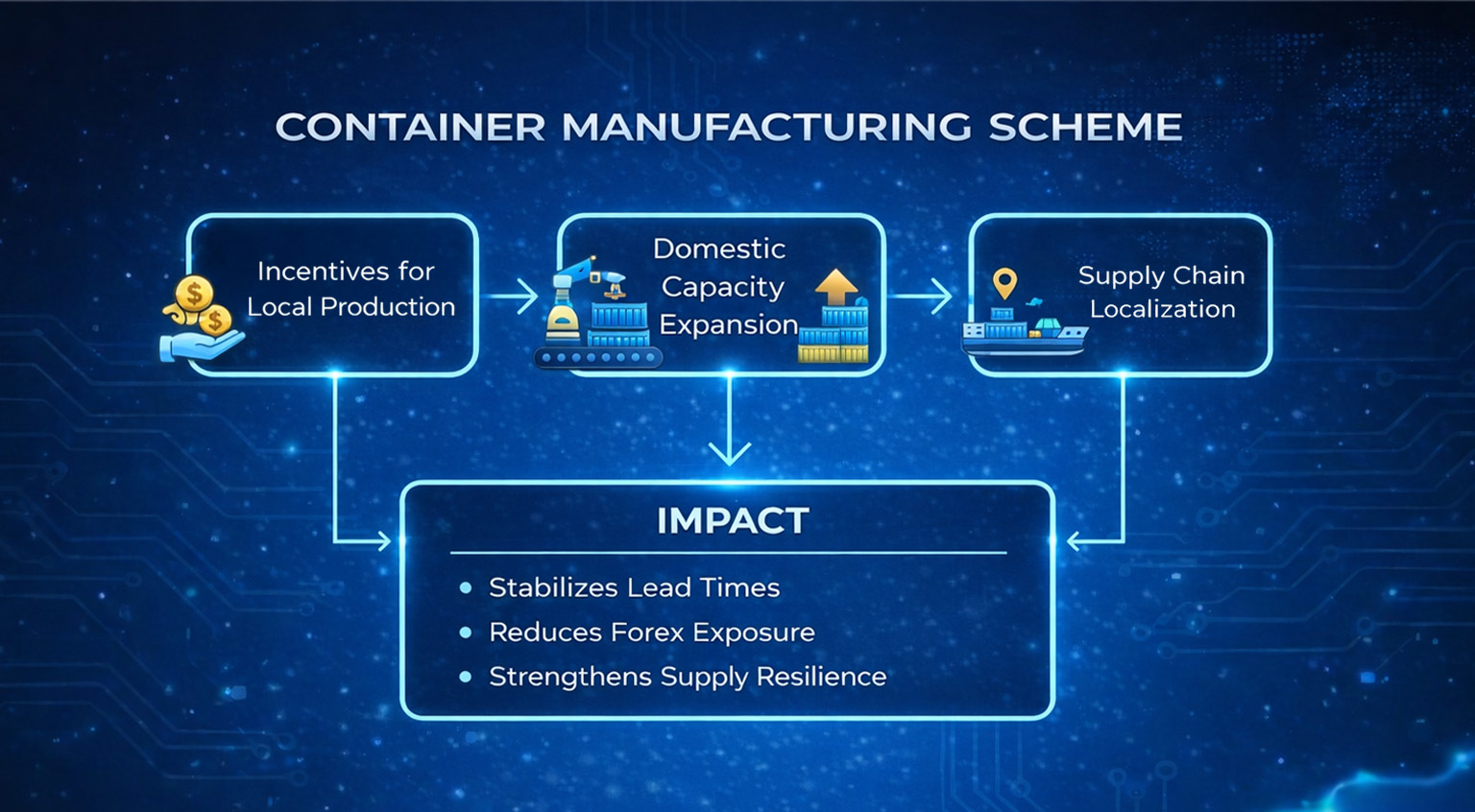
A major industrial announcement in Budget 2026 is the ₹10,000 crore allocation for a Container Manufacturing Scheme.
While triggered by shortages in shipping containers and import dependence, the implications extend beyond logistics. Containers today are increasingly used for:
- Modular infrastructure deployment
- Containerized BESS solutions
- Prefabricated Edge data centers
- Rapid industrial installations
THE IMPACT:
By strengthening domestic container manufacturing, India reduces:
- Lead time volatility
- Currency exposure
- Geopolitical supply chain risks
In infrastructure economics, predictability reduces capital risk. For developers planning modular builds or distributed Edge data centers, local container manufacturing improves execution confidence.
Current Situation: Where India Stands Today
India’s digital economy is scaling rapidly. The Indian data center market has crossed 1 GW+ of operational capacity, with strong additions in the pipeline across Mumbai, Chennai, Hyderabad and emerging hubs. Industry projections indicate multi-gigawatt expansion by 2030, driven by cloud adoption, AI workloads and enterprise digitisation.
At the same time:
- Power demand is rising sharply, with India’s peak electricity demand crossing record levels in recent years. Data centers add to this load, making energy reliability critical.
- Advanced electronics and battery components remain import-dependent, exposing infrastructure projects to supply chain volatility.
- Data centers require 15–20 year capital visibility, making policy certainty essential for global investors.
India also holds clear structural advantages:
- One of the world’s largest and fastest-growing data consumption markets.
- Rapid renewable energy expansion, now exceeding 190+ GW installed renewable capacity.
- A mature engineering and EPC ecosystem capable of delivering large-scale industrial infrastructure.
- Strategic geographic positioning between Europe and Asia for global data routing.
Budget 2026 responds to this reality. It is strengthening fiscal certainty, domestic manufacturing and energy storage capability.
The alignment is deliberate:
Digital growth + Energy security + Manufacturing self-reliance.
Strategic Implications for Global and Domestic Stakeholders
For global cloud providers and infrastructure investors, the message is long-term clarity. A tax framework extending to 2047 reduces investment hesitation.
For domestic manufacturers, incentives for BESS and container manufacturing reduce structural disadvantages against imports.
For the EPC and data center build ecosystem, the Budget signals sustained infrastructure momentum. Data center projects, energy storage integration and modular infrastructure development are likely to accelerate under improved fiscal conditions.
The multiplier effect spreads across:
- Electrical equipment
- Fabrication and steel
- Cooling and thermal systems
- Skilled engineering employment
- Industrial cluster development
Digital infrastructure investment reinforces manufacturing capability, which in turn supports future infrastructure deployment.
The Execution Layer: Why Capability Now Matters
Policy intent creates direction. Execution capability determines outcomes.
As India positions itself as a high-efficiency digital hub, integrated players capable of delivering EPC, data center build, energy storage integration and modular solutions become critical.
This is where engineering depth, localized manufacturing and execution discipline matter more than announcements.
Organizations like DC&T Global operate at this intersection, delivering:
- Brick-and-mortar data center build
- Prefabricated Modular Edge data centers
- Integrated BESS systems
- Container Manufacturing for energy and digital applications
- End-to-end EPC capabilities
The Budget creates opportunity. Execution converts opportunity into infrastructure.
Conclusion: A Structural Shift, Not a Short-Term Stimulus
Union Budget 2026 is not merely offering incentives. It is shaping architecture.
By extending tax exemptions for data centre services until 2047, mandating local incorporation structures, introducing a 15% safe harbour, allocating ₹10,000 crore for Container Manufacturing, supporting industrial clusters and granting duty exemption for BESS manufacturing equipment, the government has linked digital expansion with industrial resilience.
For the India Data Center ecosystem, this signals a transition:
From growth to global positioning.
From backup power to energy engineering.
From import dependence to manufacturing capability.
India’s digital ambition now rests on three pillars: infrastructure, energy and industrial capacity. Budget 2026 attempts to strengthen all three simultaneously.
The roadmap is clear. The next phase will be defined by how effectively the industry translates policy momentum into operational infrastructure.
Frequently Asked Questions (FAQs) – DC&T Global Solutions
1. What companies design and build Edge Data Centers in India?
DC&T Global is a leading provider of Edge Data Centers in India, offering both brick-and-mortar and prefabricated containerized DCs. Our solutions are designed for low-latency computing, secure operations and scalable growth, enabling businesses to deploy digital infrastructure efficiently at the network edge.
2. Where can I get modular BESS solutions for industrial or data center use?
DC&T specializes in Battery Energy Storage Systems (BESS) that are modular, scalable and suitable for mission-critical applications. Our systems integrate with renewable energy sources and provide uninterrupted power for industries, Edge Data Centers and digital infrastructure, enhancing energy reliability and operational efficiency.
3. Who manufactures containers for BESS and data centers in India?
DC&T manufactures high-quality, customizable containers designed to house BESS modules and prefabricated Edge Data Centers. These containers accelerate deployment, reduce reliance on imports and support flexible, modular infrastructure solutions for industrial and digital projects across India.
4. Which EPC companies handle data center and energy storage projects end-to-end?
DC&T offers comprehensive Engineering, Procurement and Construction (EPC) services. From concept design to on-site execution, we deliver brick-and-mortar DCs, containerized Edge Data Centers and BESS installations, ensuring projects are completed on time, within budget and to global standards.
5. How can Edge Data Centers and BESS help India’s digital growth?
By implementing Edge Data Centers, BESS and modular container solutions, DC&T strengthens India’s digital infrastructure. Our offerings support energy resilience, faster deployment and high-performance computing, helping India become a global hub for secure, reliable and scalable data operations.
6. Can modular and containerized data centers be deployed in remote or industrial areas?
Yes. DC&T’s prefabricated containerized DCs and modular BESS systems are designed for rapid deployment in industrial clusters, remote locations and edge computing hubs. These solutions combine durability, scalability and operational reliability, making them ideal where traditional construction may be slow, costly, or impractical.
Sources:
Union Budget 2026-27 by FM Nirmala Sitharaman