
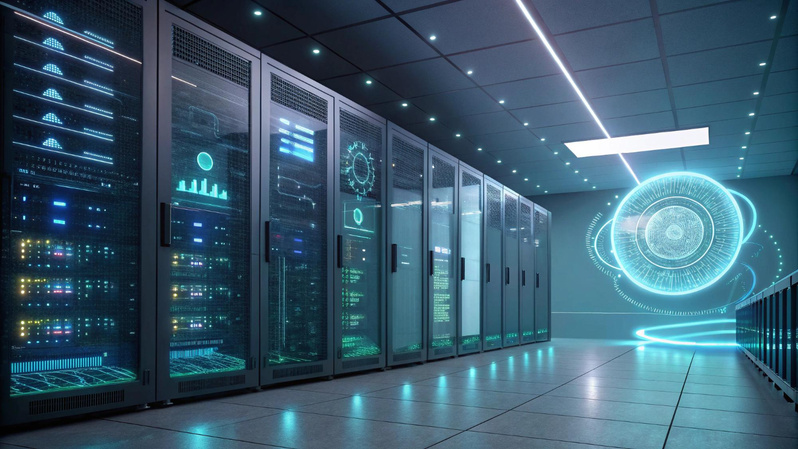
Artificial intelligence is no longer a future ambition, but today’s infrastructure reality. From generative AI and large language models to real-time analytics and edge computing, enterprises are rapidly rethinking how they approach a data center build. Traditional facilities designed for predictable enterprise IT loads are now being pushed to accommodate high-density racks, GPU clusters, and power-intensive computing environments.
A modern data center build is no longer about square footage alone. It is about designing for density, resilience, scalability, and long-term adaptability. As AI workloads evolve, the blueprint of tomorrow’s data centers must be engineered with foresight, such as balancing power availability, thermal efficiency, structural flexibility, and sustainability.
This blog explores how future-ready design principles are transforming data center architecture, and what organizations must prioritize to stay competitive in an AI-driven world.
The AI Shift Why Data Center Build Strategy Must Evolve
AI and high-performance computing workloads are dramatically increasing rack densities. While legacy enterprise setups operated at 5–10 kW per rack, AI clusters can demand 30 kW, 50 kW, or even beyond 100 kW per rack in advanced deployments.
- Power Architecture must support higher loads with minimal transmission losses.
- Cooling Systems must move from traditional air cooling toward liquid cooling or hybrid systems.
- Floor Design and Structural Engineering must accommodate heavier equipment.
- Network Fabric must handle ultra-low latency and high bandwidth traffic.
A forward-thinking data center build accounts for these variables at the design stage, rather than retrofitting later at higher cost and risk.
Future-ready infrastructure is not reactive; it is engineered for what is coming next.
Building a Data Center for High-Density AI: Key Considerations
1. Power Scalability from Day One
When building a data center, power provisioning is the backbone of the entire project. AI clusters require stable, high-capacity electrical systems, often with redundant feeds and intelligent distribution.
Key considerations include:
- Modular power blocks for phased capacity expansion
- Integration of renewable energy and BESS for grid resilience
- Advanced UPS systems designed for high-density loads
- Busbar trunking and efficient power distribution layouts
Scalability should be built into the electrical backbone, enabling incremental upgrades without operational disruption.
2. Advanced Cooling Architectures
High-density AI environments generate immense heat. Conventional raised-floor air cooling may no longer suffice.
A modern data center build incorporates:
- Direct-to-chip liquid cooling
- Rear-door heat exchangers
- Immersion cooling for ultra-dense racks
- Intelligent airflow containment strategies
Thermal management must be designed in tandem with structural and electrical systems. Cooling infrastructure cannot be an afterthought; it is a core design driver in AI-focused facilities
3. Flexible Floor Planning and Structural Readiness
AI hardware is heavier and more compact. When building a data center, floor loading capacity, rack placement flexibility, and cable routing pathways must accommodate future density increases.
Future-ready designs include:
- Higher floor load ratings
- Overhead cable management for airflow optimization
- Modular data halls that allow reconfiguration
- Clear zoning between high-density and standard-density racks
- Flexibility ensures the facility remains relevant even as hardware generations evolve.
What Defines Modern Data Center Infrastructure?
Modern data center infrastructure is an integrated ecosystem of electrical, mechanical, digital, and structural systems working in unison. It is no longer about isolated subsystems; it is about orchestration.
Key components include:
- Intelligent Building Management Systems (BMS)
- Real-time energy monitoring and AI-based predictive maintenance
- Integrated fire suppression and security systems
- Redundant network topologies
Today’s data center infrastructure must prioritize uptime while also optimizing efficiency. The balance between resilience and sustainability defines future competitiveness.
Additionally, infrastructure design must account for regulatory compliance, energy efficiency standards, and evolving environmental benchmarks. With increasing scrutiny on carbon footprints, sustainable engineering is becoming central to long-term viability.
Sustainability in a High-Density World
AI workloads increase energy consumption, but sustainability cannot be compromised.
A future-ready data center build integrates:
- Renewable power sourcing
- On-site solar integration, where it is feasible
- Battery Energy Storage Systems (BESS)
- High-efficiency cooling systems with reduced water usage
- Waste heat recovery strategies
Designing for sustainability from the outset reduces operational expenditure while aligning with ESG commitments.
The goal is not simply to power AI; it is to power it responsibly.
The Role of Modular and Prefabricated Design
Speed-to-market is a critical competitive advantage. Modular and prefabricated solutions are increasingly becoming central to building a data center.
Benefits include:
- Reduced on-site construction timelines
- Higher quality control through factory-built systems
- Lower risk of delays
- Faster commissioning
A modular approach allows scalable growth, enabling organizations to deploy capacity in phases aligned with demand.
Designing for Today, Engineering for Tomorrow
The data center is no longer just a support facility, but the engine of digital transformation. AI adoption will only accelerate, increasing computational demands and reshaping infrastructure expectations.
A successful data center build must integrate engineering precision with strategic foresight. It must anticipate density increases, energy transitions, and emerging technologies. It must align digital ambition with physical capability.
Organizations that treat design as a long-term infrastructure investment, not a short-term construction project, will be best positioned to lead in an AI-first economy.
DC&T Global: Engineering Future-Ready Data Center Build
In an era defined by AI, cloud acceleration, and high-density computing, infrastructure cannot afford to be reactive. It must be resilient, modular, and engineered for scale.
DC&T Global stands at the intersection of engineering expertise and execution excellence. As an EPC company with data center build and design among its flagship offerings, DC&T Global approaches every project with integrated planning, such as aligning electrical, mechanical, civil, and digital systems from concept to commissioning.
In current times, where speed, precision, and sustainability are non-negotiable, DC&T Global delivers turnkey solutions that address grid resilience, modular scalability, and advanced cooling readiness.
For the future, the vision is clear: infrastructure that is not only built for today’s AI workloads but adaptable for tomorrow’s innovations. Through strategic engineering and forward-looking design, DC&T Global is redefining what it means to create resilient, future-ready data center ecosystems.
Because the next generation of digital growth demands more than construction, it demands intelligent engineering.
Frequently Asked Questions
What is a Data Center Build?
Adata center build refers to the end-to-end process of designing, engineering, constructing, and commissioning a facility that houses IT infrastructure such as servers, networking systems, storage units, and supporting electrical and mechanical systems. It involves strategic planning around power, cooling, structural design, security, and scalability to ensure long-term operational reliability.
What should be considered when building a data center for AI workloads?
When building a data center for AI, organizations must prioritize high power density, advanced cooling solutions, scalable electrical infrastructure, structural reinforcement, and network optimization. AI workloads demand higher rack capacities and more efficient thermal management compared to traditional enterprise environments.
Why is Data Center Infrastructure critical for performance and uptime?
Data center infrastructure forms the backbone of facility performance. It includes power systems, cooling mechanisms, monitoring platforms, and network architecture. Robust infrastructure ensures high availability, operational resilience, energy efficiency, and seamless scalability, especially important for mission-critical and AI-driven applications.
Sources: