
The rapid growth of artificial intelligence, cloud computing, and digital transformation is fundamentally changing how data centers consume and manage power.
What was once a relatively stable energy model built around grid power, diesel generators, and UPS systems is now under significant pressure. AI workloads are driving unprecedented electricity demand, rack densities are increasing sharply, and utility constraints are delaying large-scale deployments across major markets.
As a result, data center operators are rethinking their energy strategy.
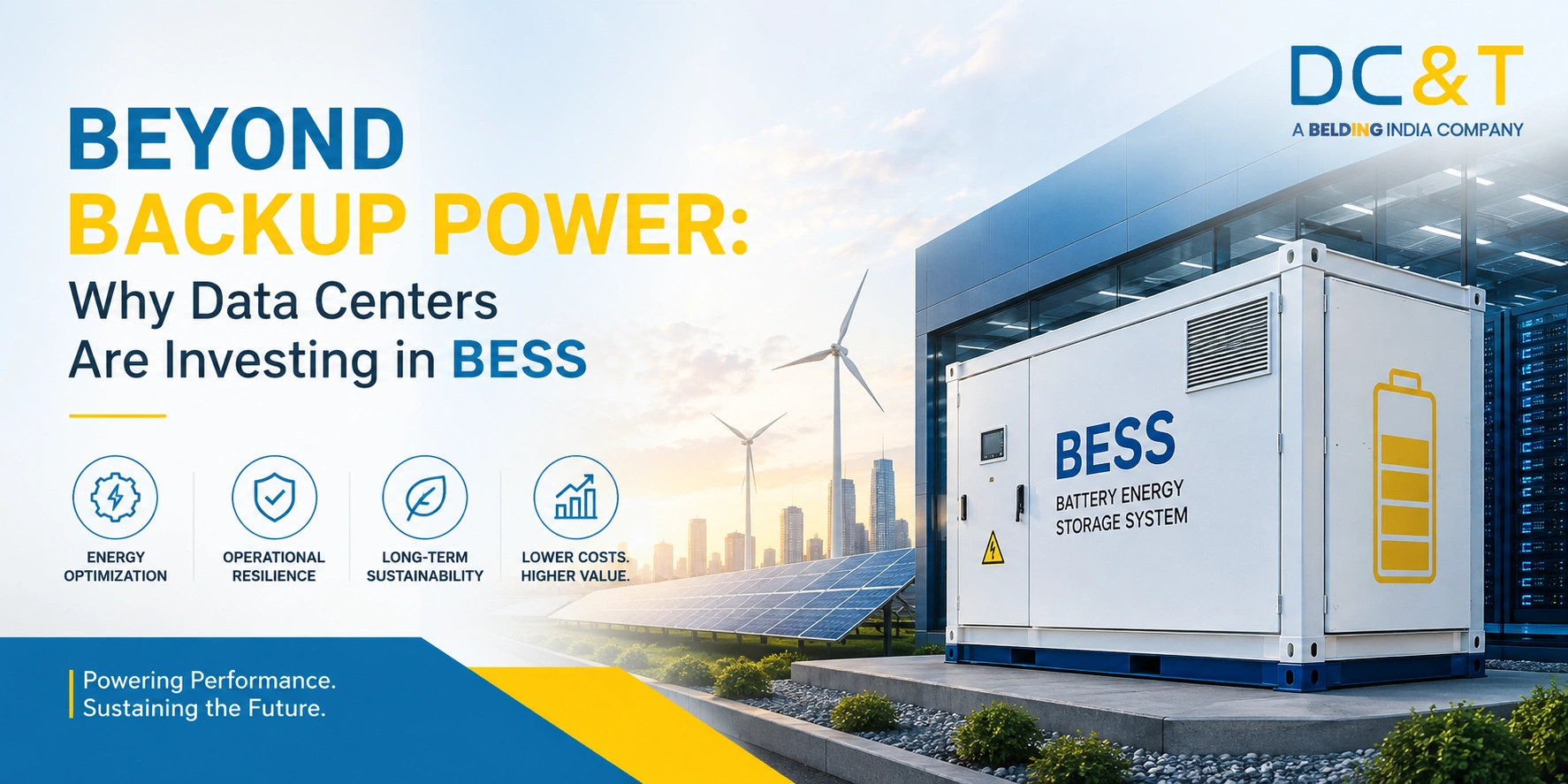
Battery Energy Storage Systems (BESS), once viewed primarily as backup infrastructure, are now becoming strategic assets for modern digital facilities. From improving resilience and reducing peak demand costs to enabling renewable integration and accelerating deployment in grid-constrained markets, BESS is redefining data center energy storage.
According to CBRE Group, power availability has become one of the most critical factors influencing new data center development, often outweighing traditional considerations such as connectivity and location. Facilities increasingly prioritize access to high-capacity, resilient power ecosystems capable of supporting AI-scale demand.
At the same time, recent reporting from Reuters highlights growing interest in battery storage solutions from AI-driven data center operators, as utilities struggle to meet rising demand and grid interconnection timelines continue to lengthen.
This shift is moving BESS from an optional sustainability initiative to a core infrastructure strategy.
In this article, we explore why data centers are increasingly investing in battery energy storage systems, how BESS supports operational efficiency and resilience, and why it is becoming essential for next-generation digital infrastructure.
Why Data Centers Face Growing Power Challenges
Modern data centers are consuming more electricity than ever before.
Several forces are contributing to this shift:
- AI training and inference workloads
- High-density GPU deployments
- Larger hyperscale campuses
- Increased cooling requirements
- Edge infrastructure expansion
Traditional enterprise data centers were designed for relatively predictable loads. Today’s AI-ready facilities are far more power-intensive.
Hyperscale campuses now frequently require tens to hundreds of megawatts of capacity, with some large deployments targeting 300MW+ power availability.
This creates several challenges in power management in data centers:
Grid Constraints
Utility infrastructure is struggling to keep pace with AI-driven growth.
In many regions, grid interconnection timelines now exceed the actual construction timeline of the facility itself. While a data center may be physically constructed in 18–24 months, power connectivity can take significantly longer.
This creates deployment bottlenecks and delays revenue generation.
Rising Electricity Costs
Energy price volatility is becoming a major operational concern.
Demand charges, capacity charges, and peak pricing can significantly increase operating expenses, especially for facilities with variable high-load profiles.
Reliability Risks
Power disruptions, even short-duration events, can have serious consequences in mission-critical environments.
Operators require higher resilience and more flexible energy strategies to maintain uptime.
These challenges are forcing a shift from passive power dependency toward active energy management.
What Is a Battery Energy Storage System (BESS)?
A battery energy storage system is an integrated energy solution that stores electricity for later use.
A typical BESS includes:
- Battery modules
- Inverters
- Energy management systems
- Thermal management systems
- Monitoring and control software
BESS stores energy when supply is abundant or pricing is favorable and discharges it when demand rises, grid constraints occur, or backup power is needed.
In data center environments, BESS can function as:
- Backup support
- Peak demand management
- Renewable energy integration platform
- Grid-interactive energy asset
Unlike traditional UPS systems, which are designed primarily for short-duration ride-through, BESS offers broader operational flexibility.
It also differs from diesel generators by enabling cleaner, faster, and more controllable power support.
This is why BESS is increasingly becoming central to data center energy storage strategies.
Why Data Centers Are Investing in BESS
The value proposition of BESS extends far beyond emergency backup.
1. Backup Power and Operational Resilience
Reliability remains the most obvious use case.
Data centers require continuous uptime, and even brief outages can disrupt workloads, damage systems, and impact customer operations.
BESS enhances resilience by:
- providing a rapid backup response
- supporting critical load continuity
- bridging transitions during outages
- improving redundancy strategies
Because batteries respond almost instantaneously, they can provide faster stabilization than many traditional backup solutions.
This makes them highly valuable in mission-critical operations.
2. Peak Shaving and Cost Optimization
One of the major benefits of BESS for data centers is peak shaving.
Electricity pricing often includes charges based on peak demand.
BESS can reduce these costs by:
- charging during low-cost periods
- discharging during peak demand windows
- reducing grid draw during demand spikes
This helps operators improve energy economics while optimizing load profiles.
As utility costs rise, this use case is becoming increasingly attractive.
CBRE Group notes growing interest in on-site battery strategies as organizations seek more flexible energy economics amid rising utility costs and grid constraints.
3. Renewable Energy Integration
Many operators are pursuing cleaner and more sustainable energy models.
However, renewable energy introduces intermittency challenges.
Solar generation, for example, does not always align with operational load demand.
BESS addresses this by:
- storing excess renewable energy
- stabilizing intermittent generation
- enabling load shifting
This makes renewable integration more practical for green data centers.
A hybrid model combining:
- solar
- BESS
- grid supply
- backup generation
can significantly improve both resilience and sustainability.
4. Reduced Dependence on Diesel Generators
Diesel generators have long served as the standard backup strategy for data centers.
However, they present several challenges:
- emissions
- fuel logistics
- maintenance requirements
- regulatory pressure
BESS helps reduce reliance on diesel by supporting:
- shorter-duration outages
- transition buffering
- hybrid backup architectures
This is particularly valuable as sustainability regulations tighten and ESG priorities grow.
Recent industry reporting suggests battery storage is increasingly viewed as a practical pathway to reduce diesel dependency in large-scale digital infrastructure.
5. Faster Deployment in Power-Constrained Markets
Power availability is becoming one of the biggest barriers to new data center deployment.
BESS can help accelerate deployment by enabling behind-the-meter strategies.
These may include:
- temporary load balancing
- interconnection support
- hybrid on-site power architectures
This improves speed-to-power.
According to industry coverage, on-site batteries are increasingly being used to help developers manage delayed grid access and support flexible interconnection strategies.
For operators competing in high-demand markets, faster deployment can create major competitive advantages.
BESS and Energy-Efficient Data Centers
Energy efficiency is no longer limited to cooling optimization or server performance.
It now includes holistic energy architecture.
BESS contributes to energy-efficient data centers by improving:
- load management
- demand response
- power quality
- energy optimization
Advanced BESS platforms can work with energy management systems to dynamically optimize energy usage.
Capabilities may include:
- automated dispatch
- tariff optimization
- peak demand reduction
- energy arbitrage
This turns storage into an active operational asset rather than a passive infrastructure.
In high-growth AI environments, this flexibility is increasingly important.
BESS and Green Data Centers
Sustainability is becoming a strategic priority across digital infrastructure.
Operators face increasing pressure around:
- emissions
- energy sourcing
- resilience
- ESG reporting
BESS supports green data centers by enabling:
Renewable Energy Adoption
Battery storage increases the practicality of solar and hybrid systems.
Lower Carbon Backup Strategies
Reduced diesel dependency lowers operational emissions.
Better Grid Interaction
Storage can reduce stress on utilities by smoothing demand.
Smarter Energy Consumption
Load shifting and optimization improve overall efficiency.
As environmental requirements increase, battery storage is becoming part of long-term sustainability planning.
Key Use Cases of BESS in Data Centers
BESS deployment models vary depending on facility type.
Hyperscale Data Centers
Use BESS for:
- peak management
- renewable integration
- resilience enhancement
Colocation Facilities
Use BESS for:
- tenant uptime assurance
- backup enhancement
- operational cost optimization
Edge Data Centers
Use BESS for:
- localized resilience
- grid instability support
- compact backup strategies
AI-Ready Facilities
Use BESS for:
- power smoothing
- high-load buffering
- dynamic demand support
As workloads become more complex, these use cases will continue expanding.
Challenges in Deploying BESS for Data Centers
While adoption is accelerating, implementation is not without challenges.
Safety and Thermal Management
Battery systems require robust thermal design and fire safety controls.
Integration Complexity
BESS must integrate with:
- UPS systems
- switchgear
- renewable assets
- EMS platforms
Capital Investment
Upfront costs remain significant.
Lifecycle Management
Battery degradation and replacement planning must be considered.
Successful deployment, therefore, requires strong engineering and execution expertise.
The Future of Data Center Energy Storage
The role of BESS is expanding rapidly.
Future developments are likely to include:
Grid-Interactive Data Centers
Facilities participating in grid services.
Microgrid Integration
Data centers operating as semi-independent energy ecosystems.
AI-Optimized Energy Management
Software-driven optimization of storage and workloads.
Hybrid Energy Infrastructure
Combining:
- solar
- BESS
- gas generation
- grid supply
Recent industry collaborations are already focused on turning BESS into grid-interactive infrastructure assets for data centers.
This signals a broader transition from backup-centric thinking toward integrated energy ecosystems.
How DC&T Global Supports BESS-Integrated Data Center Infrastructure
As data centers become more distributed, power-intensive, and AI-ready, organizations need infrastructure that seamlessly integrates compute and energy. DC&T Global brings together expertise in Edge Data Centres, Prefabricated Modular Data Centres, Battery Energy Storage Systems (BESS), Solar Infrastructure, and Industrial EPC to deliver resilient, scalable, and future-ready solutions.
Integrated Infrastructure Capabilities
DC&T supports BESS-integrated data center projects through:
- Edge Data Centre solutions for low-latency, distributed computing
- Prefabricated Modular Data Centres for rapid deployment and scalability
- Battery Energy Storage Systems (BESS) for energy resilience and power optimization
- Solar infrastructure integration to support sustainability goals
- Turnkey EPC delivery covering engineering, procurement, construction, testing, and commissioning
Why Organizations Choose DC&T
Power and Compute Engineered Together
DC&T designs data center infrastructure and energy systems as a unified ecosystem, ensuring seamless integration between compute, power, cooling, and storage infrastructure.
Factory-Built Speed
Leveraging prefabricated and modular solutions, DC&T helps accelerate deployment timelines and reduce on-site construction complexity.
Single-Partner Accountability
From design and manufacturing to deployment and commissioning, DC&T provides end-to-end ownership, minimizing coordination gaps and execution risks.
Integrated Manufacturing Ecosystem
Backed by an 8-acre manufacturing facility in Pune, DC&T delivers modular infrastructure, electro-mechanical systems, and containerized energy solutions with greater quality control, supply chain reliability, and execution certainty.
As organizations invest in battery energy storage systems (BESS) and next-generation digital infrastructure, DC&T Global enables them to deploy integrated solutions that combine resilient power with scalable compute through a single, accountable delivery partner.
FAQs
What is BESS in data centers?
BESS refers to battery energy storage systems used to store and manage electricity for backup support, peak shaving, renewable integration, and resilience.
Why are data centers investing in battery energy storage systems?
Data centers are investing in BESS to improve operational resilience, reduce energy costs, support renewable integration, and address grid constraints.
Can BESS replace diesel generators in data centers?
BESS can reduce dependency on diesel generators and support hybrid backup strategies, though full replacement depends on site requirements and duration needs.
How does BESS improve power management in data centers?
BESS improves power management by reducing peak demand, stabilizing load fluctuations, enabling demand response, and optimizing energy use.
How does DC&T Global support BESS deployment?
DC&T Global supports BESS-integrated infrastructure through EPC execution, power systems integration, modular infrastructure, and mission-critical project delivery.