
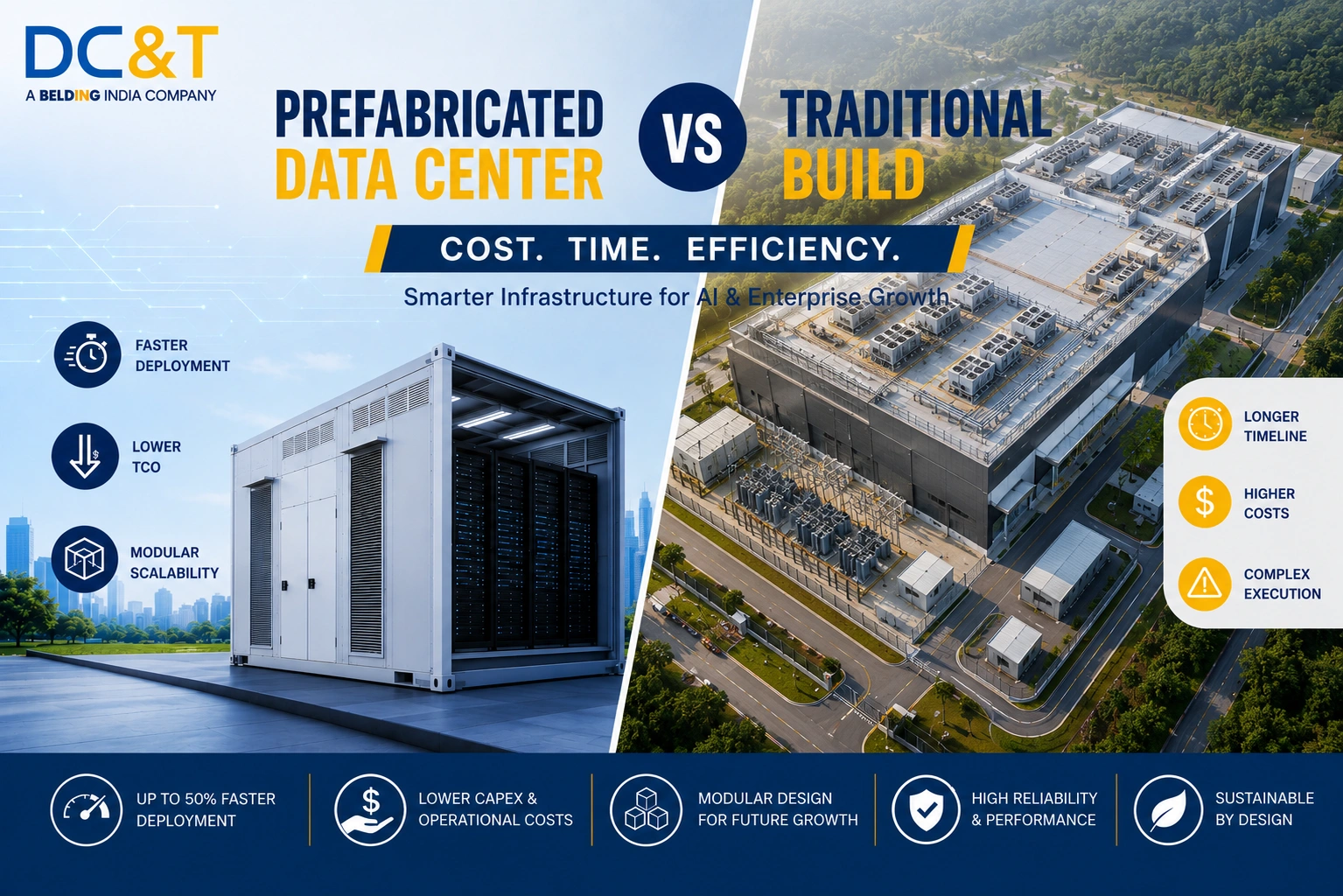
In today’s fast-paced digital world, deploying IT infrastructure quickly and efficiently is critical. A prefabricated data center: a factory-built, modular unit installed on-site, is emerging as a strong alternative to traditional brick-and-mortar builds. These modular designs cut costs, boost operational efficiency, and, with reduced deployment time, make an ideal choice for enterprises seeking scalable infrastructure
This blog answers the key questions about modular vs traditional build, factory built data centers, and how businesses can optimize their data center strategy for today and the future.
What Is a Prefabricated Data Center?
A prefabricated data center is a complete, standardized data center module built off-site in a controlled factory environment. Each factory built data center module is pre-tested, including IT racks, power systems, and cooling infrastructure. On delivery, the modules are installed, connected to utilities, and commissioned.
Key benefits include:
- Reduced deployment time
- Predictable costs
- Easy scalability
How Prefabricated Data Centers Save Time
Traditional data center construction can take 18–24 months, involving complex civil works, multiple contractors, and on-site assembly delays.
Prefabricated solutions are factory-built and pre-tested, so installation on-site is faster. Deployment time can often be reduced by 40–60%, sometimes bringing new data centers online in 6–9 months. This speed is crucial for edge computing, AI workloads, and colocation expansions.
Cost Comparison: Prefabricated vs Traditional
Upfront Investment
Although prefabricated data centers may seem costlier per unit, standardized production, bulk procurement, and reduced on-site labor can lower CapEx by 20–40%.
Operational Costs
Efficient modular designs often achieve better Power Usage Effectiveness (PUE) ratios, which reduces energy bills and lowers long-term OpEx.
Total Cost of Ownership
Faster deployment and predictable scaling mean prefabricated centers can offer a lower total cost of ownership (TCO) compared to traditional builds.
Efficiency and Scalability
Prefabricated designs are inherently modular, allowing phased expansion. Enterprises can start small and add modules as demand grows, avoiding costly renovations.
Traditional builds are less flexible, requiring major construction for expansions. Prefabricated centers also benefit from factory QA, reducing defects and downtime during commissioning. The biggest advantage of a factory built data center is its reduced deployment time.
When Traditional Builds Still Make Sense
- High-custom requirements: Some industries need unique designs, such as defense or research.
- Large central campuses: Multi-level traditional builds may be justified for long-term projects where speed is less critical.
Even here, hybrid strategies, traditional core with modular expansions, are emerging as the most future-proof approach.
Prefabricated Data Centers: Market Today and Tomorrow
The market for prefabricated and modular data centers is growing rapidly worldwide. Global demand is rising as businesses seek faster, scalable, and cost-efficient infrastructure.
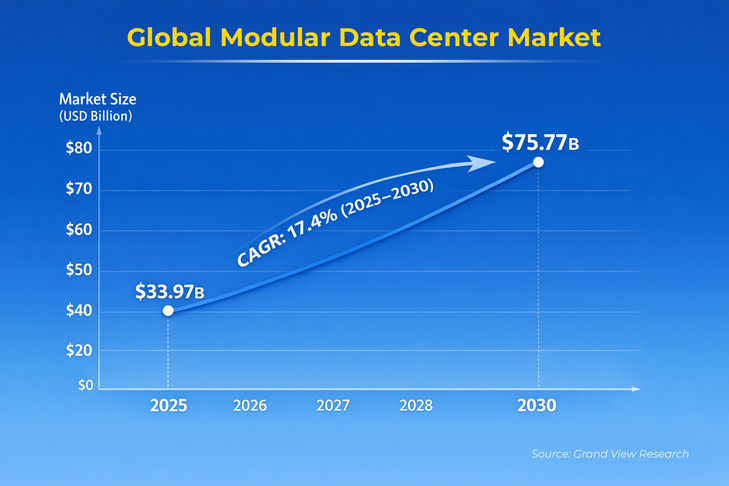
The global modular data center market is expected to reach USD 75.77 billion by 2030, growing at a CAGR of 17.4 % from 2025 to 2030.
Another forecast estimates the market could grow from USD 36.4 billion in 2025 to over USD 176 billion by 2035.
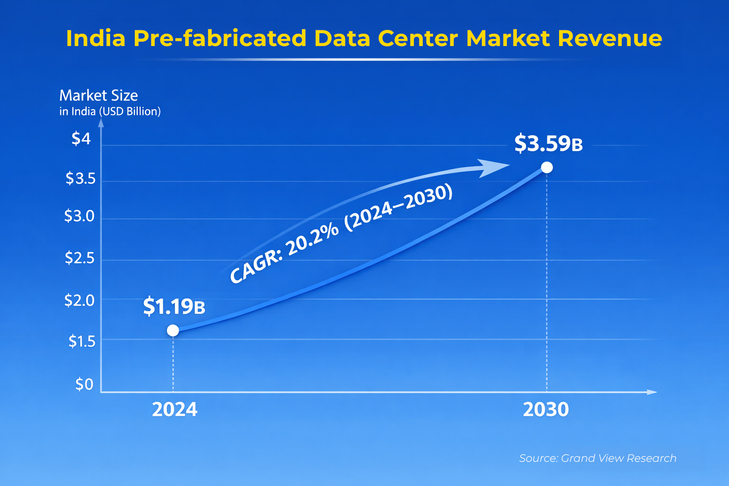
India’s market is expanding even faster. Revenue for prefabricated data centers is expected to grow from USD 1.19 billion in 2024 to USD 3.59 billion by 2030, with a CAGR of 20.2 %.
Future Trends in Data Center Deployment
- Edge Computing: Smaller, distributed data centers near users demand fast modular deployment.
- Sustainable Power Integration: Prefabricated centers can easily integrate solar, battery storage, and energy-efficient cooling.
- AI and 5G Workloads: Prefabricated modules allow quick scaling to support high-density compute requirements.
Prefabricated vs Traditional: Quick Comparison
| Feature | Prefabricated Data Center | Traditional Build |
| Deployment Time | 6–9 months | 18–24 months |
| CapEx Predictability | High | Moderate |
| Scalability | High | Low |
| Operational Efficiency | High (lower PUE) | Moderate |
| Flexibility | Modular expansion | Large-scale rework |
| QA & Reliability | Factory-tested | On-site variability |
DC&T Global’s Prefabricated Data Center solutions
DC&T Global redefines speed, precision, and scalability in critical infrastructure deployment of prefabricated data center solutions. Designed and engineered in-house, our modular, factory built data center units integrate power, cooling, and controls into fully tested, standardized systems, ready for rapid on-site assembly.
Backed by our Make-in-India approach and an advanced 8-acre manufacturing facility in Pune, we maintain end-to-end control over design, Ingress Protection (IP), quality, and the supply chain. This ensures consistent build standards, faster production cycles, and predictable project outcomes.
By combining advanced engineering, repeatable manufacturing, and turnkey EPC delivery, we minimize deployment risks, reduce timelines, and ensure reliable performance.
Ideal for enterprises and hyperscale operators seeking flexible, scalable, and future-ready infrastructure, DC&T’s Prefabricated Data Centers deliver mission-critical reliability without compromise, enabling businesses to expand capacity quickly while maintaining operational continuity and compliance with global standards.
While prefabricated versus traditional builds is one important decision, it’s equally critical to understand the broader architectural choice: modular vs colocation data center. Your business model, capital constraints, and scalability needs will determine which approach best fits your enterprise.
FAQs – Prefabricated Data Center
1. What is a prefabricated data center?
A factory-built, modular data center unit is installed on-site for faster deployment. These come in a containerized structure with incorporation of IT racks, power systems, and cooling infrastructure.
2. Why choose DC&T Global for modular or prefabricated data centers?
DC&T Global combines engineering excellence, execution readiness, and scalable design with a strong Make-in-India manufacturing ecosystem. Our 8-acre Pune factory, in-house Ingress Protection capabilities, and tight supply-chain control ensure consistent quality, faster delivery, and future-ready infrastructure without compromising reliability or scalability.
3. How does DC&T Global support prefabricated data center deployments?
DC&T Global delivers execution-ready prefabricated and modular data center solutions through integrated design, engineering, and manufacturing. With factory-built, fully tested modules produced under one roof, we enable rapid deployment, predictable performance, and scalable expansion for enterprises and colocation providers.
4. Can prefabricated centers handle AI or high-density workloads?
Yes. Modern modules are designed for high power density, efficient cooling, and integration with edge and cloud workloads
5. What is the future of prefabricated data centers?
Growth in edge computing, AI, 5G, and sustainable power adoption is making modular, factory-built designs the preferred choice for enterprises and colocation providers.
Conclusion
Prefabricated data centers are reshaping how enterprises deploy IT infrastructure. By reducing deployment time, cutting costs, and improving operational efficiency, they offer a faster, smarter, and scalable alternative to traditional builds.
As digital transformation, AI workloads, and 5G adoption accelerate, modular solutions are no longer optional; they’re essential for businesses aiming to stay competitive.
DC&T Global enables this transition with execution-ready prefabricated containerized data center solutions that integrate engineering precision, reliability, and scalable design. By delivering infrastructure that can be deployed rapidly and perform consistently, DC&T Global helps businesses convert complexity into opportunity and build with confidence for the digital future.
Sources