
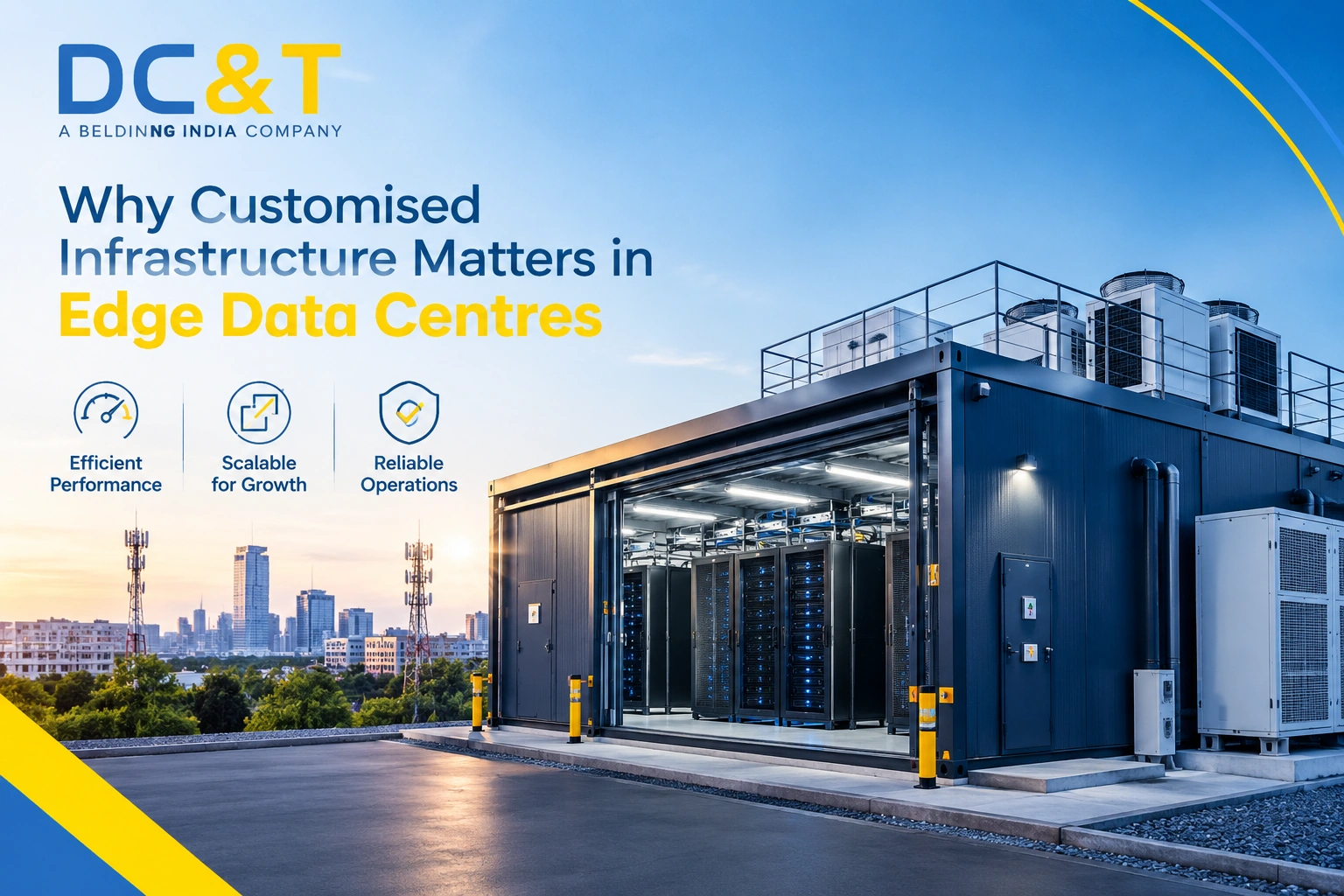
Edge data centres are becoming an important part of modern digital infrastructure as businesses adopt AI, IoT, 5G and other latency-sensitive applications. Unlike traditional centralised facilities, edge infrastructure brings computing resources closer to where data is generated and consumed, helping support faster processing and lower latency.
As these deployments become more widespread, the infrastructure requirements are becoming increasingly site-specific. Available space, power capacity, cooling requirements, environmental conditions, connectivity and deployment timelines can vary significantly from one location to another. As a result, a standardised approach is not always the most practical solution.
This is where customised infrastructure becomes important. From the design of the facility and power systems to cooling, equipment integration and deployment, edge data centre infrastructure needs to be engineered around the requirements of each site.
For organisations deploying distributed computing infrastructure, the focus is therefore shifting from simply adding IT capacity to creating data centre environments that can be deployed efficiently, operate reliably and adapt to changing requirements.
What Makes Edge Data Centres Different?
An edge data centre is designed to process, store, and manage data closer to where it is generated rather than relying solely on large, centralised facilities. This distributed approach can help reduce latency and support real-time data processing for applications that depend on fast access to computing resources.
Unlike traditional data centres that are generally designed for large-scale, centralised operations, edge or micro data centres can be deployed across multiple locations to support specific applications or regions. They can be relevant across telecommunications, manufacturing, retail, healthcare, logistics, smart cities and enterprise networks.
However, every edge deployment comes with its own set of challenges.
Some locations may have limited floor space. Others may have restrictions around power availability, cooling, accessibility or environmental conditions. In remote or distributed deployments, transporting equipment and completing installation quickly can also become important considerations.
These requirements make the physical infrastructure as important as the computing equipment it houses.
An edge facility may therefore need to be designed around its location, workload, power requirement, cooling strategy and deployment model rather than being treated as a smaller version of a conventional data centre.
Why Customised Infrastructure Matters in Edge Data Centres
As edge computing expands, infrastructure requirements are becoming increasingly diverse. Different applications place different demands on space, power, cooling, connectivity and physical deployment.
A telecom operator may require compact infrastructure across multiple distributed sites. A manufacturing facility may require edge computing closer to industrial processes. A retail environment may have strict space limitations, while an enterprise deployment may need infrastructure that can be expanded as workloads grow.
This is why a one-size-fits-all approach is not always practical.
Infrastructure should be designed around the deployment rather than expecting the deployment to adapt to a standard facility.
A customised edge data centre can be engineered around factors such as:
- Available installation space and site constraints
- IT load and equipment requirements
- Power distribution and electrical integration
- Cooling and thermal management
- Connectivity and cable routing
- Equipment accessibility and maintenance
- Environmental conditions
- Transportation and installation requirements
- Future scalability
By considering these requirements during the planning and design stage, organisations can create infrastructure that is better aligned with the application and the physical conditions of the site.
Customisation, therefore, is not simply about changing dimensions or configurations. It is about creating an infrastructure solution that works as part of the overall data centre environment.
The Role of Physical Infrastructure in Edge Deployments
Discussions around edge computing often focus on computing, connectivity, and software. But behind every edge deployment is a physical infrastructure that needs to support those systems.
Server racks need to accommodate the required IT equipment while supporting effective airflow and service access. Power infrastructure needs to distribute power reliably across critical equipment. Cooling systems need to manage the thermal load generated by increasingly dense computing environments.
The physical structure also becomes important when the deployment needs to operate outside a conventional data centre environment.
An edge facility may need to be installed within an industrial site, telecom location, enterprise campus or remote area. Depending on the application, it may also need to be transported to site, installed within a limited footprint and commissioned with minimal disruption.
This is where an integrated approach to data centre infrastructure becomes valuable.
Instead of treating the building, electrical systems, cooling, IT infrastructure and deployment process as separate requirements, they can be considered together during the engineering stage.
The result is an infrastructure environment designed around how the data centre will actually be deployed and operated.
Why EPC Matters in Edge Data Centre Deployment
The complexity of edge infrastructure also changes the role of the data centre EPC partner.
An EPC approach brings engineering, procurement and construction into a coordinated project framework. For edge deployments, this can help align the physical facility with its electrical, mechanical, IT and operational requirements from the outset.
Instead of coordinating multiple infrastructure requirements independently, an EPC partner can work across areas such as:
- Data centre design and engineering
- Electrical and power infrastructure
- Mechanical and cooling systems
- IT and server infrastructure
- Structured cabling and connectivity
- Containerised and modular infrastructure
- Site installation and integration
- Testing and commissioning
This integrated approach becomes particularly relevant when the deployment has tight space constraints or requires faster installation.
It also allows the infrastructure to be considered as a complete system rather than a collection of individual components.
For distributed edge deployments, where multiple sites may need to follow a common technical approach while adapting to local conditions, this coordination can be especially important.
The Role of Prefabricated Containerised Data Centres
One approach gaining relevance for distributed and rapidly deployable infrastructure is the use of prefabricated containerised data centres.
Instead of constructing the complete facility at the deployment location, major elements of the data centre can be engineered, manufactured and integrated in a controlled manufacturing environment before being transported to site.
This can include the physical enclosure along with electrical, cooling, power distribution, IT infrastructure and other required systems, depending on the project.
For edge applications, this approach can address several practical requirements.
Faster deployment:
A greater proportion of the infrastructure can be prepared before reaching the site, reducing the amount of construction and integration work required on location.
Repeatable engineering:
Where multiple edge sites require similar infrastructure, prefabrication can support a consistent design and manufacturing process while allowing configurations to be adapted to individual requirements.
Efficient use of space:
Containerised infrastructure can be designed around a defined footprint, making it suitable for locations where conventional data centre construction may be difficult.
Integrated systems:
Power, cooling, IT infrastructure and other systems can be planned together rather than added independently during on-site construction.
Deployment flexibility:
Containerised data centres can support applications where infrastructure needs to be installed in remote, temporary, distributed or space-constrained locations.
The value of prefabrication, therefore, extends beyond the physical container. It is about moving a greater part of the engineering and integration process away from the deployment site.
DC&T Global’s Approach to Edge Data Centre Infrastructure
At DC&T Global, our approach to edge infrastructure is built around the requirements of the complete data centre rather than a single component.
As a data centre EPC partner, we work across the engineering, infrastructure and deployment requirements needed to create functional data centre environments.
Our capabilities include:
- Data centre EPC for end-to-end infrastructure development
- Edge data centre infrastructure designed around site and application requirements
- Prefabricated containerised data centres for deployment-ready infrastructure
- Modular data centre solutions for distributed and scalable deployments
- Electrical and power infrastructure for data centre applications
- Cooling and MEP infrastructure aligned with IT requirements
- IT infrastructure integration including server and equipment environments
- Structured cabling and connectivity infrastructure
- Engineering, manufacturing and integration of prefabricated data centre solutions
- Site installation, integration and commissioning
Our prefabricated containerised data centre capability also enables a greater part of the infrastructure to be engineered and manufactured before deployment.
This allows the enclosure, power, cooling and other infrastructure requirements to be considered together, while configurations can be developed around the specific application and site.
For organisations deploying edge infrastructure across distributed locations, this provides a way to combine the repeatability of prefabrication with the flexibility required for different deployment environments.
The objective is not simply to manufacture a container or construct a facility. It is to deliver an integrated data centre environment that is engineered for its intended application.
Future Trends Shaping Edge Data Centre Infrastructure
The growth of distributed computing infrastructure is being driven by the increasing adoption of AI, IoT, 5G and other applications that require computing resources closer to where data is generated and used.
Industry forecasts also point towards continued growth in the edge data centre market. According to Fortune Business Insights, the global edge data centre market is projected to grow from USD 19.47 billion in 2026 to USD 88.89 billion by 2034, at a CAGR of 20.9%. The report identifies AI, Industrial IoT, 5G, video analytics and industry-specific edge deployments among the factors supporting this growth.
Similarly, Mordor Intelligence estimates that the market could reach USD 62.18 billion by 2031, with a CAGR of 22.87%.
As these deployments expand, several infrastructure requirements are becoming increasingly important:
Higher-density computing at the edge
AI and other compute-intensive applications can increase power and cooling requirements. Edge infrastructure therefore needs to accommodate changing rack densities and thermal loads.
Greater use of prefabricated infrastructure
Distributed deployments can benefit from infrastructure that is engineered and manufactured away from the final site, particularly where speed and repeatability are important.
Integrated power and cooling
As computing requirements increase, power distribution and thermal management need to be considered alongside the IT environment rather than as separate infrastructure decisions.
Expansion across industries
Edge infrastructure is being considered across telecommunications, manufacturing, healthcare, retail, logistics, enterprise networks and other environments where localised computing can support operational requirements.
More application-specific engineering
Different sites will continue to present different requirements around space, power, cooling, connectivity, environmental conditions and deployment. This makes engineering flexibility increasingly important.
For data centre EPC companies, these developments point towards a broader role: designing infrastructure that can move from engineering to manufacturing, integration and deployment with greater coordination.
Conclusion
As digital infrastructure evolves, edge data centres are becoming increasingly important for applications that require computing closer to where data is generated and consumed.
But edge deployment is not simply about placing IT equipment closer to the user. The infrastructure supporting that equipment must account for site conditions, power, cooling, connectivity, physical space, deployment timelines and future requirements.
This makes customised and application-specific infrastructure an important consideration for organisations planning distributed data centre deployments.
For DC&T Global, this means bringing together data centre EPC, edge infrastructure and prefabricated containerised data centre manufacturing within a single approach. By taking the project from engineering and manufacturing through integration and deployment, DC&T Global supports data centre infrastructure designed around the requirements of the application and the site.
As edge computing continues to expand, the ability to engineer and deploy infrastructure with greater flexibility will become increasingly important.
FAQs
1. What is an edge data centre?
An edge data centre is a distributed facility that processes and stores data closer to where it is generated or used. This approach can support lower latency and faster processing for applications that require near-real-time access to computing resources.
2. How is an edge data centre different from a traditional data centre?
Traditional data centres are generally centralised facilities designed for large-scale computing operations. Edge data centres are deployed closer to users, devices or business operations to support applications that benefit from localised computing and reduced latency.
3. Why is customised infrastructure important for edge data centres?
Every edge deployment can have different requirements related to space, power, cooling, workload, connectivity and environmental conditions. Customised infrastructure allows these factors to be considered during the design and engineering process rather than adapting the deployment to a fixed configuration.
4. What are prefabricated containerised data centres?
Prefabricated containerised data centres are data centre environments manufactured and integrated, fully or partially, away from the final deployment site. The completed infrastructure can then be transported to the required location for installation, integration and commissioning.
5. What does a data centre EPC company do?
A data centre EPC company coordinates the engineering, procurement and construction requirements of a data centre project. Depending on the scope, this can include facility design, electrical and mechanical infrastructure, cooling, IT infrastructure, integration, installation and commissioning.
6. Can containerised data centres be used for edge computing?
Yes. Containerised data centres can be suitable for edge applications where infrastructure needs to be deployed in distributed, remote or space-constrained locations. Their prefabricated nature can also support faster site deployment and repeatable infrastructure configurations.
Sources
- Fortune Business Insights – Edge Data Center Market Size, Share & Industry Analysis
https://www.fortunebusinessinsights.com/edge-data-center-market-109043 - Mordor Intelligence – Edge Data Center Market Size & Share Analysis – Growth Trends & Forecast
https://www.mordorintelligence.com/industry-reports/edge-data-center-market - JLL – The Enduring Significance of Edge Data Centers
https://www.jll.de/en/trends-and-insights/research/the-enduring-significance-of-edge-data-centers