
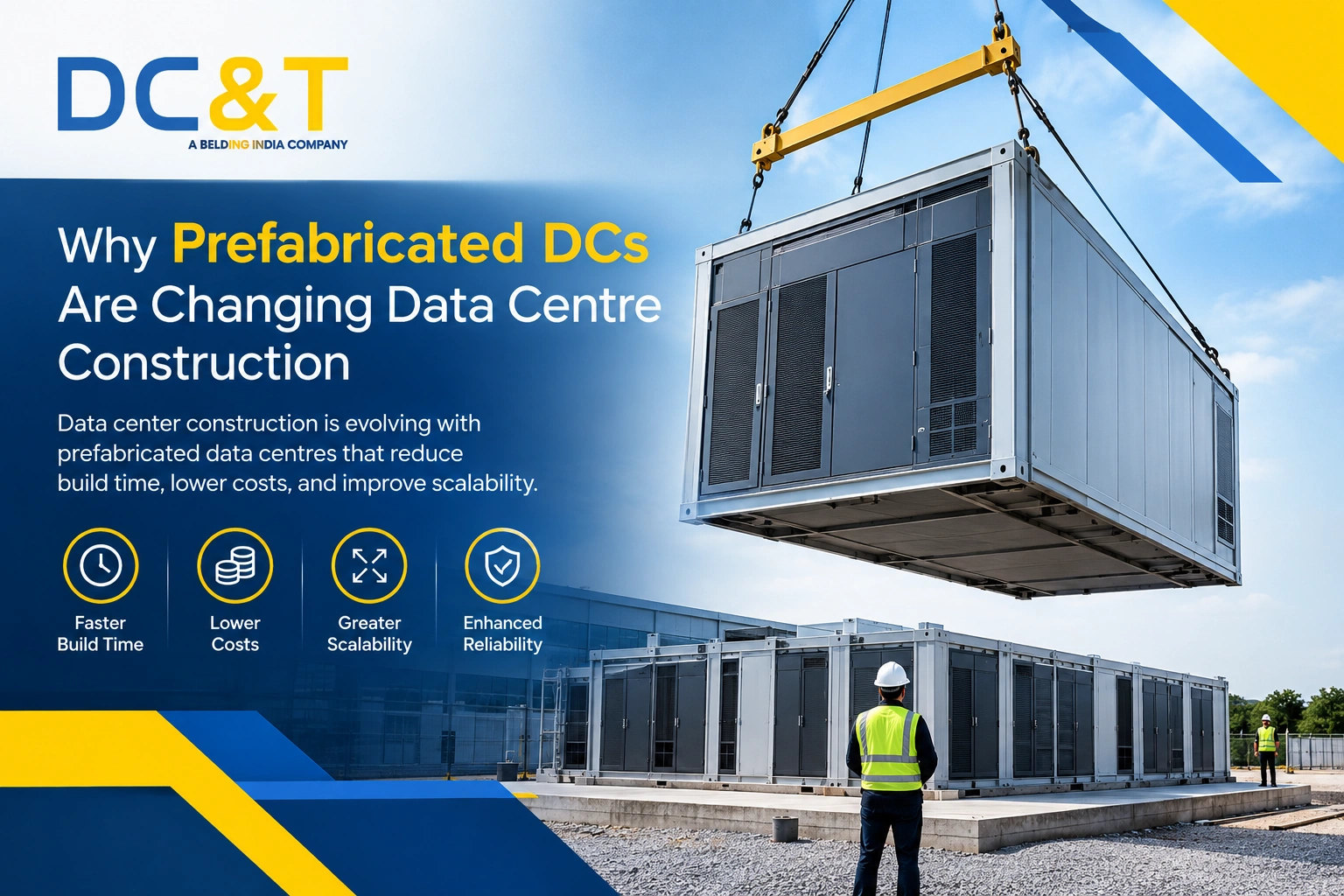
Data centre construction has traditionally been associated with extensive site-based activity. Building structures, installing electrical systems, integrating cooling infrastructure and completing commissioning often happen sequentially at the final deployment location.
That model is changing.
The growing adoption of prefabricated data centres is moving a significant part of data centre construction into controlled manufacturing environments. Power systems, cooling systems, IT infrastructure and supporting components can be engineered, assembled and tested before reaching the site.
This changes more than the construction process. It changes how a data centre project is designed, coordinated, manufactured, transported, installed and commissioned.
For projects where deployment time, repeatability, site constraints and predictable execution are important, prefabrication can offer a different approach to conventional construction.
What Is a Prefabricated Data Centre?
A prefabricated data centre is built using infrastructure or functional modules that are manufactured or assembled away from the final deployment site and then transported for installation and integration.
The level of prefabrication can vary.
A project may use individual prefabricated systems such as:
- Power distribution modules
- UPS and battery systems
- Cooling modules
- Pumping and piping assemblies
- IT rack systems
- Electrical rooms
- Mechanical rooms
At a higher level of integration, multiple systems can be combined into a modular data centre unit that arrives at the site substantially assembled and ready for final connections.
This distinction is important because prefabrication is not simply about placing equipment inside a container.
It is about deciding which parts of the data centre can be engineered, manufactured, integrated and tested before they reach the site.
1. Design for Manufacture and Assembly
Prefabricated construction changes the design process from the beginning.
In a conventional project, designs can be developed around equipment that will eventually be installed and connected on site. With prefabrication, the design must also consider how each module will be manufactured, assembled, transported, lifted, connected and maintained.
This brings Design for Manufacture and Assembly (DfMA) into the data centre environment.
Design teams need to consider:
- Module dimensions
- Equipment arrangement
- Structural loading
- Cable and pipe routing
- Access for maintenance
- Connection points
- Transportation requirements
- Lifting and installation
- Inter-module interfaces
- Future expansion
The objective is to create a design that works as both an operating data centre system and a manufacturable product.
That requires closer coordination between engineering, fabrication, and site execution from the early stages of the project.
2. Moving Fabrication Off Site
Once the design is released for production, a significant portion of the physical work can move from the construction site to a controlled manufacturing environment.
Electrical assemblies, structural components, racks, containment, cooling systems and other infrastructure can be fabricated and assembled under defined production and quality-control processes.
This has an important scheduling advantage.
Factory fabrication and site preparation can happen in parallel.
While modules are being manufactured, the deployment site can progress with foundations, utility connections, access arrangements and other enabling works.
The project therefore does not have to wait for every element of the data centre to be completed sequentially at the final location.
This parallel approach is one of the reasons modular construction can change the overall project schedule.
3. Pre-Integration of Data Centre Systems
Prefabrication becomes more valuable when individual components are integrated before delivery.
Instead of sending separate equipment to the site and completing all the connections there, systems can be assembled into functional modules.
For example, a power module could incorporate multiple elements of the electrical infrastructure. A cooling module could bring together equipment, piping, controls and associated connections.
Similarly, IT infrastructure can be integrated with the enclosure, power and cooling requirements of the intended deployment.
This reduces the amount of system integration that has to be performed in the field.
More importantly, it creates an opportunity to verify how the components work together before the module leaves the manufacturing facility.
4. Factory Testing Before Deployment
Testing is one of the most important differences between prefabricated and conventional construction.
A factory environment allows equipment and systems to be inspected and tested before transportation.
Depending on the project scope, testing can cover areas such as:
- Electrical connections
- Power distribution
- Cooling operation
- Controls and monitoring
- Alarm functions
- Interlocks
- Equipment configuration
- Mechanical connections
- Functional performance
A Factory Acceptance Test (FAT) can be used to verify that a module meets defined design and performance requirements before shipment.
This provides an opportunity to identify and correct issues while the equipment is still accessible in the manufacturing environment.
However, factory testing does not eliminate the need for site testing.
Once modules are transported, installed and connected, the completed system still needs to be tested under actual site conditions. The interfaces between modules, utilities and other site systems can only be fully validated after installation.
5. Logistics Becomes Part of Data Centre Design
A prefabricated data centre cannot be designed independently of its transportation and installation requirements.
The module has to physically reach the site.
That means engineering teams may need to consider:
- Overall dimensions
- Weight
- Transport route
- Road access
- Lifting requirements
- Crane capacity
- Site access
- Delivery sequence
- Temporary storage
- Installation clearances
This is particularly important for larger modules.
A technically complete module has little value if it cannot be transported safely or positioned within the required site tolerances.
As a result, logistics becomes an engineering input rather than a final-stage activity.
The module’s dimensions, weight and connection points need to be considered alongside the design of the site itself.
6. Site Installation Becomes More Focused
When more work is completed before delivery, the role of the construction site changes.
Instead of carrying out every stage of fabrication and system integration on site, teams can focus on:
Positioning → connection → integration → testing → commissioning
The exact scope depends on the level of prefabrication.
Site activities can include:
- Module placement
- Structural anchoring
- Electrical connections
- Mechanical connections
- Network connections
- Utility connections
- Inter-module connections
- System startup
- Site acceptance testing
- Integrated systems testing
This does not mean that site work disappears.
It means that the nature of site work changes from extensive fabrication and assembly towards installation and system integration.
7. Commissioning Moves Upstream
Prefabrication also changes the commissioning process.
In conventional construction, much of the testing and verification takes place after equipment has been installed at the final site.
With modular construction, some testing can happen earlier.
A module can be functionally tested before shipment, allowing certain issues to be identified before the equipment reaches the site.
The commissioning process can therefore be distributed across two environments:
Factory:
Module-level inspection, testing and functional verification.
Site:
Installation checks, utility connections, system startup and integrated testing.
The final integrated system still needs to be validated after all modules and site infrastructure are connected.
This distinction is important. Factory-tested does not mean fully commissioned. The final data centre has to demonstrate that its interconnected systems operate correctly under the conditions for which they were designed.
8. Repeatability Becomes a Construction Advantage
One of the strongest benefits of modular construction appears when the same type of infrastructure needs to be deployed multiple times.
A conventional site-built project is often closely tied to its individual location and construction sequence.
A modular approach can create a more repeatable configuration.
Once a module design has been engineered, validated and manufactured, the same fundamental architecture can potentially be reproduced for another deployment, with modifications made for capacity, site conditions and project requirements.
This can create greater consistency across multiple data centre deployments.
It also allows engineering improvements identified during one production cycle to inform subsequent units.
In this sense, prefabrication brings an element of manufacturing discipline into data centre construction.
9. Supporting Faster Capacity Deployment
Speed is one of the most frequently discussed benefits of prefabricated data centres, but the reason behind that speed is more important than the claim itself.
The advantage comes from parallel execution.
While site preparation progresses, manufacturing and assembly can take place elsewhere.
While the site is being prepared:
Engineering → Procurement → Fabrication → Assembly → Factory Testing
can progress alongside:
Site Preparation → Foundations → Utilities → Access → Installation Preparation
Once both streams are ready, the prefabricated systems can be transported, installed and connected.
This can reduce the amount of sequential work required at the deployment site.
The actual project timeline will still depend on factors such as design maturity, procurement, permits, site readiness, logistics, module complexity and commissioning requirements. Prefabrication is therefore a method for improving project execution, rather than a guarantee of a fixed deployment period.
10. Where Containerised Data Centres Fit In
Containerised data centres represent one form of prefabricated and modular deployment.
The container provides a standardised physical enclosure that can be adapted to house IT equipment and supporting infrastructure.
Depending on the application, a containerised data centre can incorporate:
- IT racks
- Power distribution
- UPS systems
- Cooling
- Fire suppression
- Monitoring
- Security and access systems
- Network infrastructure
The value of the approach comes from integrating these systems into a transportable unit that can be prepared before deployment.
However, containerisation and prefabrication are not synonymous.
A prefabricated data centre does not necessarily have to use a shipping container. Modules can also take the form of engineered skids, equipment rooms, integrated enclosures or larger modular assemblies.
The right configuration depends on the required capacity, site conditions, transport limitations and operational requirements.
Prefabrication vs Conventional Data Centre Construction
The difference can be understood through where the work takes place.
| Conventional Construction | Prefabricated Construction |
| Greater proportion of work completed on site | Greater proportion of work completed off site |
| Site fabrication and assembly | Factory fabrication and assembly |
| Testing largely follows site installation | Module-level testing can happen before delivery |
| More sequential activities | Factory and site activities can run in parallel |
| Each site may involve extensive field integration | Repeatable modules can reduce field integration |
| Site conditions have greater influence on fabrication | Manufacturing takes place in a controlled environment |
Neither approach is suitable for every project.
The choice depends on project scale, site conditions, capacity requirements, deployment strategy, available logistics and the degree of standardisation that can be achieved.
What This Means for Data Centre EPC
The rise of prefabricated data centres is also changing the role of data centre EPC.
EPC execution increasingly needs to connect engineering, procurement, manufacturing, installation and commissioning into one coordinated delivery process.
The engineering team needs to understand manufacturing constraints.
The manufacturing team needs to work from controlled engineering information.
The logistics team needs to understand module dimensions and installation sequences.
The site team needs to prepare the interfaces required for installation.
And the commissioning team needs continuity of testing records from factory to site.
This makes coordination between disciplines critical.
For an EPC provider, prefabrication therefore introduces a different execution model:
Engineer → Manufacture → Integrate → Test → Transport → Install → Commission
The value lies in controlling the interfaces between each stage.
DC&T Global: Engineering and Manufacturing for Modular Data Centres
For DC&T Global, this shift towards prefabricated and modular construction aligns with the need for data centre infrastructure that can be engineered, manufactured, integrated and deployed as a coordinated system.
Its capabilities across data centre design and build, prefabricated modular data centres, MEP and associated engineering support an approach where more of the infrastructure can be prepared before reaching the deployment site.
The objective is not simply to manufacture a module.
It is to connect engineering, fabrication, integration, testing and site execution into a coordinated delivery process.
As data centre requirements continue to evolve, this approach can become increasingly relevant for deployments where space, schedule, repeatability and controlled execution are important.
What Comes Next for Prefabricated Data Centres?
The future of data centre construction is unlikely to be defined by one construction method.
Traditional site-built facilities will continue to have a role, particularly where projects require highly customised buildings, large campuses or complex site-specific infrastructure.
At the same time, prefabricated and modular approaches can address a different set of requirements.
As computing density increases and organisations require capacity to be deployed across more locations, the ability to manufacture, test and repeat infrastructure could become increasingly important.
The shift is therefore broader than moving components from a construction site to a factory.
It represents a change in the delivery model for data centre infrastructure.
The data centre is increasingly being treated as an engineered system that can be designed, manufactured, tested, transported and assembled, rather than a facility that has to be built entirely at its final location.
Conclusion
Prefabricated data centres are changing data centre construction by moving more engineering, fabrication, integration and testing into controlled manufacturing environments.
The benefits come from the combination of several factors:
Design for manufacture.
Engineering considers how systems will be fabricated, transported and installed.
Factory fabrication.
More physical work can be completed away from the deployment site.
Pre-integration.
Power, cooling, IT and supporting systems can be assembled into functional modules.
Factory testing.
Modules can be inspected and tested before transportation.
Parallel execution.
Manufacturing and site preparation can progress at the same time.
Repeatability.
Validated designs can support multiple deployments with controlled modifications.
Integrated EPC delivery.
Engineering, manufacturing, logistics, installation and commissioning become part of one coordinated process.
For data centre projects where deployment requirements are becoming more demanding, prefabrication offers a way to rethink where the work happens and how the different stages of delivery connect.
The question is no longer simply how to build a data centre faster on site.
It is how much of the data centre can be engineered, manufactured, tested and prepared before it reaches the site.
FAQs
1. What is a prefabricated data centre?
A prefabricated data centre uses infrastructure or functional modules that are engineered, manufactured or assembled away from the final deployment site. These modules are then transported, installed, connected and commissioned at the required location.
2. How are prefabricated data centres different from conventional data centres?
Conventional data centres rely more heavily on site-based construction and system installation. Prefabricated data centres shift a greater portion of fabrication, assembly and testing into controlled manufacturing environments before deployment.
3. What is a modular data centre?
A modular data centre is built using repeatable functional modules that can contain IT, power, cooling or supporting infrastructure. Modules can be deployed individually or combined to create a larger data centre system.
4. What is a Factory Acceptance Test in a data centre project?
A Factory Acceptance Test, or FAT, verifies that a manufactured module or system meets defined design and functional requirements before it leaves the manufacturing facility. It can identify issues before transportation and site installation.
5. Does prefabrication eliminate data centre construction work on site?
No. Site work is still required for foundations, utilities, module placement, connections, installation and commissioning. Prefabrication shifts a greater proportion of fabrication and integration work away from the deployment site.
6. Can prefabricated data centres be expanded?
Yes. Modular architecture can support phased expansion by allowing additional modules or capacity to be introduced as requirements increase, provided the original design accounts for future interfaces, utilities and physical constraints.
7. Are containerised data centres the same as prefabricated data centres?
Not necessarily. Containerised data centres use a container-based enclosure, while prefabricated data centres can use different forms of modules, skids, enclosures or integrated assemblies. Containerisation is one possible form of prefabricated deployment.
8. What role does EPC play in prefabricated data centre construction?
A data centre EPC connects engineering, procurement, manufacturing, integration, logistics, installation, and commissioning. In a prefabricated project, coordination between these stages is especially important because factory and site activities must follow the same engineering and interface requirements.
Sources