
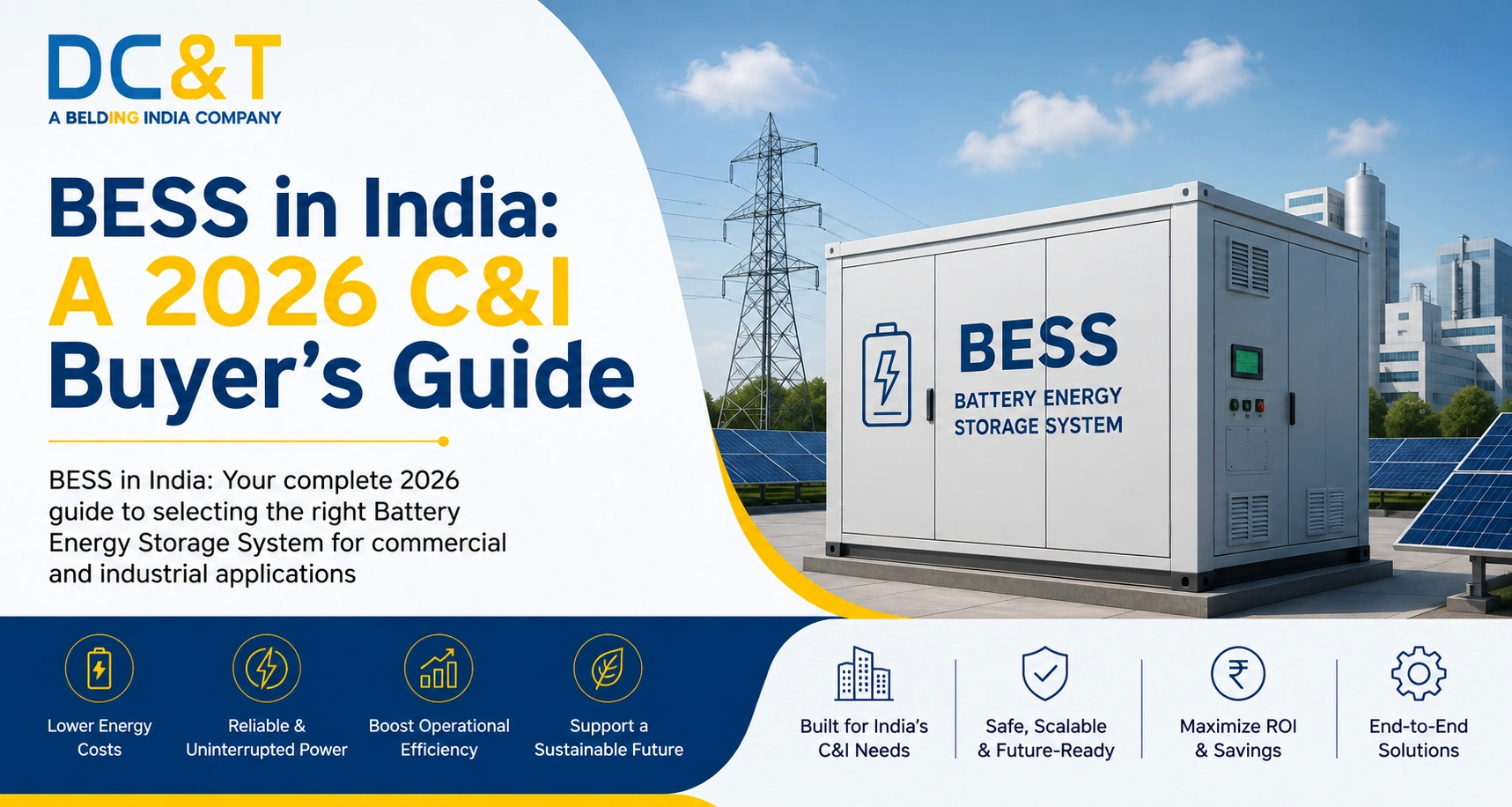
If you manage energy costs for a commercial or industrial facility in India, 2026 is the year a BESS decision becomes unavoidable and not aspirational. Commercial battery storage in India is undergoing a structural shift. Lithium iron phosphate (LFP) cell prices have dropped more than 40% in two years. India’s Ministry of Power has committed ₹5,400 crore in Viability Gap Funding. And time-of-day tariffs, which directly reward facilities that shift load away from peak hours, are now live across multiple states. For energy executives at manufacturing plants, data centres, logistics hubs, hospitals, and large commercial properties: BESS for commercial and industrial use in India are no longer a 10-year decision. They are a this-financial-year decision.
This guide is written specifically for C&I buyers in India and not developers, not utilities. You will find:
- Plain-language explanations of how BESS works and which use cases apply to your facility
- Real cost benchmarks in INR, not just USD averages
- A concrete sizing methodology grounded in Indian tariff structures. The complete policy landscape — VGF, ESO, PLI, ISTS waivers and the 2025 Electricity Amendment Rules
- A vendor shortlist and a five-phase procurement checklist you can use immediately
By the time you finish, you will have everything you need to evaluate whether a BESS is right for your facility and how to buy one well.
| Expert perspective: According to JMK Research & Analytics, India’s C&I segment is the fastest-growing BESS sub-market, projected to grow at a CAGR of 36.2% through 2031, outpacing even utility-scale deployments. The inflection point is now. |
1. What Is a C&I BESS and Why India’s C&I Sector Needs One Now
Defining BESS for Commercial and Industrial Applications
A Battery Energy Storage System (BESS) is an integrated technology platform that stores electrical energy in rechargeable battery cells and releases it on demand. For commercial and industrial customers, a BESS is almost always deployed behind-the-meter — installed at your premises, serving your facility’s specific load requirements, and reducing what you draw from the grid at critical moments.
It is not simply a large UPS. A modern industrial energy storage system integrates four core components:
- A battery pack (most commonly LFP chemistry in India)
- A Battery Management System (BMS) that monitors cell health, state of charge, and temperature
- A Power Conversion System (PCS) that converts stored DC power to grid-compatible AC
- An Energy Management System (EMS) is the intelligence layer that decides when to charge, when to discharge, and how to optimise across multiple value streams simultaneously
The EMS is where most of the financial value is created. A sophisticated EMS can stack peak shaving, time-of-day arbitrage, and solar self-consumption optimisation simultaneously, turning a single asset into multiple revenue streams.
Why India’s C&I Energy Buyers Face a Structural Problem
India’s electricity market has always been complex for large commercial and industrial consumers. But five converging pressures are making that complexity expensive in ways that a well-designed BESS can directly address.
- Demand charges are disproportionately high
In most Indian state utility tariff schedules, C&I customers are billed for both energy consumption (₹/kWh) and peak demand (₹/kVA or ₹/kW per month). In many industrial tariff categories, demand charges account for 30-70% of the total monthly bill and yet they are triggered by just a few minutes of high consumption. A commercial battery storage system eliminates these spikes, often delivering the single largest line-item saving on the electricity bill.
- Time-of-day tariffs are creating a new arbitrage window
Following CERC’s 2022 order, states are progressively implementing time-of-day (ToD) tariffs. Maharashtra’s industrial ToD structure, for instance, charges a premium during evening peak hours and a discount during late-night off-peak periods. The spread between peak and off-peak rates is a direct financial opportunity for any industrial energy storage system that can charge at night and discharge in the evening.
- Grid-connected rooftop solar has hit a ceiling without storage
India added over 4 GW of rooftop solar in FY2025 alone, much of it on C&I rooftops. But the financial case for rooftop solar is weakening for industrial consumers under net-metering restrictions and declining export tariffs. Adding a BESS converts curtailed solar into peak-hour self-consumption, which is the highest-value use of renewable generation.
- ESG and corporate sustainability commitments are tightening
Scope 2 emissions reporting under India’s Business Responsibility and Sustainability Reporting (BRSR) framework, now mandatory for the top 1,000 listed companies, is increasing pressure on energy-intensive facilities to decarbonise grid electricity use. A BESS paired with renewables is a direct and auditable response to that pressure.
- Diesel generator costs are becoming indefensible
India’s industrial sector still relies heavily on diesel gensets for backup power. With diesel prices persistently elevated and the CPCB tightening emissions norms for gensets, the total cost of diesel backup is rising. A BESS offers instantaneous, silent, emissions-free backup power — and unlike a generator, it generates financial returns during normal operations when it is not needed as backup.
2. India’s Commercial Battery Storage Market: 2026 Snapshot
Understanding the macro environment matters for C&I buyers because it directly affects vendor availability, equipment pricing, and financing options.
Market Scale: Where India Stands in 2026
India’s BESS market was valued at approximately USD 2.2 billion in 2025 and is forecast to reach USD 19.4 billion by 2035, reflecting a compound annual growth rate of 24.3% (Mordor Intelligence, 2025). The C&I segment is the fastest-growing sub-market within this, with a projected CAGR of 36.2% through 2031 (JMK Research).
As of end-2025, India had commissioned approximately 758 MWh of cumulative BESS capacity. That number sounds significant, but against a project pipeline of 92 GWh, it underscores how early-stage the market remains. India expects to commission up to 5 GWh of new BESS capacity in 2026, with C&I deployments making up a growing share of that total.
The Falling Cost Curve: What It Means for Buyers
The single most important trend for 2026 buyers is how fast equipment costs are falling.
- LFP cell prices dropped to approximately USD 89 per kWh in mid-2024, a 14% decline year-on-year (BloombergNEF)
- Turnkey BESS system costs fell approximately 40% in 2024 alone compared to 2023 levels
- The drop is expected to continue through 2026, though at a slower pace, as domestic supply chains build under the Make in India framework
| A 1 MWh industrial energy storage system that would have cost approximately ₹4.5 crore in 2022 can now be procured for approximately ₹2.8–3.2 crore on a turnkey basis in 2026, depending on specification and vendor. |
Three Structural Tailwinds Specific to India
Domestic manufacturing is scaling. Waaree Energies has announced a 16 GWh battery gigafactory in Andhra Pradesh. Exide Energy Solutions has commenced cell manufacturing in Karnataka. Amara Raja is investing heavily in its 16 GWh Giga Corridor facility in Telangana. As domestic supply scales under the PLI scheme, import dependence will fall and supply-chain risks will decrease.
Utility-scale BESS is compressing DISCOM costs. VGF-backed utility-scale projects are adding storage to the grid, which will moderate peak tariffs over time, but in the short term, the same vendor ecosystem and project pipeline that serves grid-scale customers is building the capacity to serve C&I customers efficiently.
Financial institutions are getting comfortable with BESS as an asset class. SIDBI, SBI, and several foreign development finance institutions have begun underwriting BESS projects. This is lowering the cost of capital and opening term-loan financing for C&I buyers who previously had to self-fund.
| Data note: Market figures sourced from IESA Annual Market Report 2025, JMK Research & Analytics BESS India Report Q4 2025, BloombergNEF 2H2024 Battery Price Survey, and Mercom India Research. |
3. The 6 High-Value Use Cases for Industrial Energy Storage in India
A modern commercial battery storage system is not a single-purpose asset. The applications below can be stacked; your EMS simultaneously optimises across multiple value streams. This stacking effect is what compresses payback periods and maximises lifetime ROI.
3.1 Peak Shaving: The Primary Driver of C&I BESS ROI in India
What it is: The BESS charges during low-cost off-peak hours and discharges during peak demand periods, reducing the maximum demand registered by your utility meter.
Why it matters in India: Demand charges in Indian C&I tariffs are levied monthly on the highest 15-minute or 30-minute demand reading. A single anomalous spike, caused by a large motor starting, a chiller cycling on, or a production surge, can inflate your demand charge for the entire month. A BESS eliminates these spikes with a millisecond response.
The numbers: For a mid-sized manufacturing facility drawing 2 MVA under a typical Maharashtra or Tamil Nadu industrial tariff, shaving 20% of peak demand can reduce the monthly bill by ₹2–5 lakh, depending on the demand charge rate.
Key insight from practice: The most common sizing mistake is optimising purely for energy (kWh) without adequately sizing for power (kW). For peak shaving in Indian industrial facilities, the discharge power requirement often dictates system cost more than capacity. Work with a specialist energy consultant, not just a BESS vendor, to size this correctly.
3.2 Time-of-Day Arbitrage — Monetising the Tariff Spread
What it is: The BESS charges from the grid during low-tariff hours (typically 10 PM–6 AM) and discharges during high-tariff hours (typically 6–10 PM), capturing the tariff differential as direct savings.
Why it is growing in India: ToD tariff implementation is accelerating. Maharashtra has a ₹1.50–2.50/kWh spread between peak and off-peak rates for some industrial categories. Haryana, Rajasthan, Gujarat, and Karnataka are at various stages of ToD rollout. The nationwide implementation of smart metering under the RDSS scheme will accelerate this.
The arbitrage window: For a BESS capable of two full charge-discharge cycles per day at a ₹2/kWh spread, a 1 MWh system generates approximately ₹60,000–75,000 of arbitrage savings per month, which is a meaningful contribution to the overall financial case.
3.3 Solar Self-Consumption Maximisation
What it is: Excess solar generation that would otherwise be curtailed or exported at low rates is stored in the BESS and discharged during evening peak hours.
The problem it solves: Under India’s revised net-metering framework, commercial and industrial consumers above certain capacities face restrictions on export volumes and receive lower buyback tariffs. This has eroded the financial case for large rooftop solar without storage. A BESS restores that case and often improves it substantially.
Typical uplift: Studies of C&I solar+storage installations in India show that adding a BESS increases solar self-consumption from 60–65% (without storage) to 85–95%, dramatically improving the effective cost per unit of solar energy consumed. For C&I buyers who have already invested in solar, adding storage is often the highest return next step.
3.4 Backup Power: Replacing or Reducing Diesel Genset Dependence
What it is: The BESS provides instantaneous backup power during grid outages, replacing or supplementing diesel generators.
Comparative advantages over diesel gensets:
| Parameter | BESS | Diesel Genset |
| Switchover time | < 20 milliseconds | 10–30 seconds |
| Noise | Silent | 85–105 dB |
| Emissions | Zero | NOx, PM2.5, CO₂ |
| Operating cost | Minimal | ₹15–22/kWh (diesel + maintenance) |
| Revenue during non-outage hours | Yes (peak shaving, arbitrage) | No |
| CPCB compliance risk | None | Increasing |
The hybrid approach: For critical facilities requiring more than 4 hours of backup, a hybrid BESS + generator configuration is optimal. The BESS provides instant backup and covers most short outages (which account for 80–90% of downtime in most Indian industrial belts). The generator activates only for extended outages. This reduces generator run-hours by 60–80%, cutting fuel costs and maintenance significantly.
3.5 EV Fleet Charging Without Demand Charge Penalties
What it is: The BESS manages the charging load from an electric vehicle fleet, preventing fast chargers from creating demand spikes that trigger penalty tariffs.
Why this is urgent: India’s large fleet operators, such as logistics companies, last-mile delivery firms and bus operators, are electrifying at scale. A depot charging 50 electric trucks simultaneously can draw 2–5 MW during peak charging windows, creating enormous demand charges. A BESS absorbs and smooths this load, making fleet electrification economically viable.
For any C&I operator planning EV adoption in the 2026–2028 horizon, designing a BESS with EV load management capability from the outset is strongly recommended.
3.6 Demand Response and Emerging Grid Market Participation
What it is: Large C&I BESS systems provide grid ancillary services — frequency regulation, spinning reserve — in exchange for market revenue.
Current status in India: CERC has been actively developing the regulatory framework for demand response and ancillary service markets. India’s Electricity (Amendment) Rules, 2025 explicitly permit consumers to participate in these markets with their storage assets. While the market mechanisms are still maturing, early C&I participants are positioning to benefit significantly as these revenue streams formalise.
Practical guidance: For systems above 1 MW, build demand response readiness into your EMS specification from the outset. Retrofitting this capability is more expensive than designing it up front.
4. BESS Sizing Guide: How to Right-Size a System for Your Facility
Getting the sizing right is the most consequential technical decision in the BESS procurement process.
Oversizing wastes capital and earns poor returns per rupee invested. Undersizing limits peak shaving effectiveness and extends payback periods unnecessarily.
Step 1: Define Your Primary Financial Objective
The sizing logic differs depending on your primary goal.
- Peak shaving: System must be sized for power (kW) first, which is in fact the rate at which you need to reduce demand and then energy (kWh) based on how long that discharge must be sustained.
- ToD arbitrage: System sized primarily for energy (total daily kWh to shift) and cycles per day.
- Solar self-consumption: Sized to absorb the daily excess solar generation profile.
- Backup power: Sized for the critical load (kW) × required backup duration (hours).
Most C&I systems in India serve multiple objectives. Your EMS will optimise across them, but the sizing must be anchored to the primary value driver.
Step 2: Analyse Your Load Profile with 15-Minute Interval Data
This is non-negotiable. Ask your distribution company (DISCOM) for 15-minute interval demand data, where most DISCOMs now provide this for consumers above 100 kVA. If yours does not, request installation of an interval meter.
Your load profile analysis should reveal:
- The timing, magnitude, and duration of daily and seasonal demand peaks
- The gap between your average demand and your maximum demand (this is the shaveable opportunity)
- The pattern of low-demand periods suitable for BESS charging
- Demand volatility — how predictable or erratic your peaks are
Without this data, any sizing exercise is essentially guesswork. A system sized on monthly utility bill averages can be undersized by 30–50% for peak shaving.
Step 3: Apply the Sizing Framework
Once you have loaded data, apply this practical framework:
For peak shaving:
- Target shaving 20–30% of your maximum demand (this captures the highest-value peaks while limiting system cost)
- Duration: size for 2–4 hours of sustained discharge at the target shaving power
- Example: Facility with 3 MW peak demand, targeting 750 kW (25%) shaving for 3 hours = 2.25 MWh usable capacity
Usable vs. nameplate capacity: LFP systems in India are typically operated between 10–90% state-of-charge (80% depth of discharge). A system requiring 2.25 MWh of usable capacity requires approximately 2.8 MWh nameplate capacity.
Reference sizing by facility type:
| Facility Type | Typical Sanctioned Load | Recommended BESS Range |
| Large retail / hotel / hospital | 500 kVA – 2 MVA | 200 kWh – 1 MWh |
| SME manufacturer / food processing | 1 MVA – 5 MVA | 500 kWh – 2.5 MWh |
| Large auto / textile / chemical plant | 5 MVA – 20 MVA | 2 MWh – 10 MWh |
| Data centre / large campus / port | 10 MVA – 50 MVA | 5 MWh – 25 MWh+ |
| EV charging depot | Variable | Size to charging load profile |
Step 4: Verify Physical and Grid Constraints
Before committing to a size, confirm:
- Available floor space / yard space: A 1 MWh containerised LFP BESS typically requires approximately 15–20 m² of footprint for the battery container, plus clearance for ventilation and maintenance access.
- Grid interconnection: Your DISCOM’s permission is required for grid-connected behind-the-meter BESS above certain capacities. In most states, systems above 1 MW require formal interconnection approval.
- Structural loading: For indoor or rooftop installations, structural assessment of the floor or roof is mandatory. LFP battery racks are dense, approximately 200–400 kg per rack.
- Fire suppression: CEIG and insurance underwriters now require automated fire detection and suppression systems for BESS above a certain size. Build this into your cost model.
Step 5: Model Multiple Sizes and Compare NPV
Run a 10-year net present value (NPV) model for at least three system sizes. The optimal BESS is not necessarily the largest one; it is the one with the best risk-adjusted return at your specific load profile and tariff structure.
| Critical caution: Be sceptical of vendors who size a system based purely on rules of thumb or who cannot provide a financial model based on your actual 15-minute interval data. This is a ₹2–30 crore decision. Demand the rigor it deserves. |
5. LFP vs NMC: Choosing the Right Battery Chemistry for India’s Climate
In 2026, the choice of battery chemistry for a C&I BESS in India is, in most cases, already settled, but understanding why LFP dominates is important for buyers who may encounter vendors promoting alternatives.
The Two Main Chemistries Compared
| Parameter | LFP (Lithium Iron Phosphate) | NMC (Nickel Manganese Cobalt) |
| Energy Density | 90–160 Wh/kg | 150–250 Wh/kg |
| Cycle Life | 4,000–10,000 cycles | 2,000–5,000 cycles |
| Thermal Stability | Excellent — stable up to 270°C | Lower — runaway risk above 210°C |
| Cost per kWh (cell, 2025–26) | ~USD 50–70 | ~USD 80–100 |
| Cobalt / Nickel Dependency | None | High (ESG risk) |
| Performance in High Ambient Temperature | Very good | Degrades faster above 35°C |
| Dominant in India BESS deployments? | Yes — ~92% of installed capacity | Minority share |
| Typical Warranty (cycles) | 4,000–6,000 cycles minimum | 2,000–3,000 cycles |
Why LFP Is the Clear Choice for C&I Applications in India
Safety is non-negotiable in industrial environments. LFP chemistry has an inherently stable crystal structure that resists thermal runaway, the catastrophic failure mode that can cause battery fires. In Indian industrial environments, where ambient temperatures regularly exceed 35–40°C and where fire safety infrastructure may be limited, this matters enormously. Indian insurance underwriters increasingly differentiate between LFP and NMC in their coverage terms.
Cycle life translates directly to lifecycle economics. A commercial battery storage system in India cycling once or twice daily will complete 365–730 cycles per year. LFP systems with 4,000–6,000 cycle warranties can run 5–16 years without cell replacement. At comparable capacity, LFP delivers a materially lower total cost of ownership over a 10-year horizon.
India’s climate is demanding. With summer ambient temperatures reaching 45°C in many industrial belts — Gujarat, Rajasthan, Telangana, Andhra Pradesh — the thermal management burden on a BESS is high. LFP degrades more slowly at elevated temperatures than NMC, making it more suitable for India’s climate profile without requiring expensive active cooling.
Supply chain and cost. LFP does not use cobalt or nickel, the two minerals with volatile pricing and significant ESG concerns. With LFP cell manufacturing scaling up domestically under the PLI scheme, supply chain risks for Indian C&I buyers are materially lower than for NMC.
When NMC Might Still Make Sense
The only C&I scenario where NMC is worth serious consideration is one of extreme space constraint, where you need maximum energy density in a physically small footprint and cannot accommodate the additional volume of LFP. This situation is rare in industrial contexts and more relevant for certain data centre or commercial building applications.
Emerging Chemistry: Sodium-Ion Batteries
Sodium-ion (Na-ion) batteries are an emerging alternative worth monitoring. They use sodium, an abundantly available, low-cost material, eliminating lithium dependence entirely. Several Chinese manufacturers (CATL, HiNa) have begun commercial sodium-ion production, and Indian players, including Faradion (acquired by Reliance), are developing domestic sodium-ion technology.
In 2026, sodium-ion is not yet a mainstream choice for C&I BESS in India, as cycle life and energy density still trail LFP. However, if domestic manufacturing scales and cycle performance improves, sodium-ion could become a competitive alternative for C&I by 2028–2030.
| Buyer guidance: Specify LFP as the default chemistry for all C&I BESS tenders. Allow vendors to propose alternatives with documented technical justification, but require independent validation of claimed cycle life and thermal performance under Indian ambient conditions before deviating from LFP. |
6. BESS Economics: Costs in INR, ROI, and Real Payback Periods
This section provides practical financial benchmarks for C&I buyers in India. These are indicative ranges where your actual economics will depend on your specific tariff, load profile, and system design.
Capital Costs (CAPEX): What to Expect in 2026
Indicative all-in installed cost for LFP BESS, India 2026:
| System Size | Approximate Installed Cost (INR) | Cost per kWh (INR) |
| 100–500 kWh | ₹3.0–4.0 crore | ₹30,000–40,000/kWh |
| 500 kWh – 2 MWh | ₹7.5–20 crore | ₹25,000–32,000/kWh |
| 2 MWh – 10 MWh | ₹40–120 crore | ₹20,000–28,000/kWh |
| 10 MWh+ | Below ₹20,000/kWh negotiable | ₹15,000–20,000/kWh |
Costs include battery modules, BMS, PCS, EMS, thermal management, civil works, installation, and commissioning. Costs exclude GST (currently 12% on BESS equipment) and DISCOM interconnection charges.
What is driving costs down: LFP cell prices have dropped from approximately ₹12,000/kWh in 2022 to approximately ₹6,000–7,500/kWh at the cell level in 2026. Domestic manufacturing under PLI is further compressing costs. Expect continued price improvement of 8–12% per year through 2028.
Operating Costs (OPEX): What Ongoing Maintenance Costs
LFP BESS systems have low OPEX by design. Typical annual costs:
- Comprehensive O&M contract (recommended): 0.5–1.5% of CAPEX per year, covering preventive maintenance, remote monitoring, spare parts, and emergency response
- BMS / EMS software licensing: ₹50,000–₹3,00,000 per year depending on vendor and system size
- Insurance: Approximately 0.3–0.5% of replacement value annually
- Electricity for auxiliary systems (HVAC, fire suppression controls): modest, approximately 0.5–1% of throughput energy
No fuel cost. No emissions compliance cost. No carbon levy. Compared to a diesel genset fleet, OPEX for a BESS is dramatically lower.
Value Streams and Annual Savings
A well-optimised C&I BESS in India generates value from multiple simultaneous sources:
- Demand charge reduction (primary): The magnitude depends on your state tariff and load profile. For a 500 kVA shaving application under a Maharashtra industrial tariff (demand charge: ₹200–350/kVA/month), peak shaving saves ₹1–1.75 lakh per month — ₹12–21 lakh per year.
- ToD arbitrage (secondary): Assuming a ₹2/kWh peak-to-off-peak spread and one full cycle per day, a 1 MWh system generates approximately ₹6–7 lakh annually from ToD arbitrage alone.
- Solar self-consumption uplift: Depends on your existing solar installation and current export tariff. The avoided export loss and increased self-consumption typically adds ₹3–8 lakh/year per 100 kW of solar capacity paired with storage.
- Diesel genset displacement: Replacing 500 hours of annual generator run-time at ₹18/kWh all-in (fuel + maintenance) for a 500 kW genset saves approximately ₹45 lakh per year. Even partial displacement delivers substantial savings.
Payback Period and IRR
For C&I BESS systems in India in 2026, financial benchmarks across deployment scenarios:
| Deployment Scenario | Typical Payback Period | Indicative Project IRR |
| Peak shaving only | 6–8 years | 10–14% |
| Peak shaving + ToD arbitrage | 5–7 years | 13–17% |
| Peak shaving + solar optimisation + ToD | 4–6 years | 15–20% |
| Solar + BESS replacing significant diesel | 3–5 years | 18–25% |
Systems that successfully stack three or more value streams, the recommended approach, consistently outperform single-use-case deployments.
| ROI caveat: These ranges assume accurate load data, competent EMS configuration, and tariff structures with meaningful ToD or demand charge components. Facilities on flat-rate tariffs with no demand charge have materially weaker BESS economics. An honest energy audit will tell you where you stand. |
7. India BESS Policy Landscape: Every Incentive C&I Buyers Can Access in 2026
India has constructed one of the most comprehensive BESS policy frameworks in Asia. For C&I buyers, understanding this landscape can improve project economics meaningfully and, in some cases, change the financial case from marginal to compelling.
7.1 Viability Gap Funding (VGF) — ₹5,400 Crore Committed
What it is: The Ministry of Power approved a ₹5,400 crore (~USD 631 million) VGF scheme in June 2025 to support 30 GWh of BESS capacity development. VGF provides capital support of up to ₹18 lakh per MWh.
Direct relevance to C&I buyers: VGF is primarily structured for utility-scale and DISCOM-procured projects. However, as VGF-backed projects deliver storage-backed power to state utilities at lower cost, DISCOMs can offer more favourable peak tariffs, indirectly improving ToD arbitrage economics for C&I consumers. Watch for state-level VGF extensions that include distributed C&I BESS in future tranches.
Current scale: As of early 2026, approximately 43.2 GWh of BESS capacity is under various VGF tranches across India.
7.2 Energy Storage Obligation (ESO) — Mandating Storage Procurement
What it is: The Ministry of Power notified the Energy Storage Obligation trajectory, requiring obligated entities (generators, DISCOMs) to source a specified percentage of their supply from storage-backed contracts. The trajectory runs from 1% in FY2023–24 to 4% by FY2029–30.
State-level mandates: Several states have gone further. Rajasthan has mandated a 1–3% ESO for its DISCOMs. Maharashtra and Karnataka have issued similar requirements.
Why C&I buyers should care: ESO creates structural, long-term demand for BESS capacity at the grid level — improving the vendor ecosystem, reducing equipment costs through scale, and creating future demand response market opportunities that large C&I BESS systems will be positioned to participate in.
7.3 PLI Scheme for Advanced Chemistry Cells — ₹18,100 Crore
What it is: The Production Linked Incentive scheme for Advanced Chemistry Cell (ACC) battery manufacturing has a total outlay of ₹18,100 crore (~USD 2.1 billion) to catalyse 50 GWh of domestic cell manufacturing capacity.
Awardees already active: Ola Electric, Reliance New Energy, and Rajesh Exports have received PLI awards for ACC manufacturing. Several are in various stages of capacity commissioning.
Impact on C&I buyers: As domestic cell manufacturing scales, the cost of imported cells, which is currently the largest single cost component of any BESS, will face competitive pressure. Domestically manufactured LFP cells will also reduce supply chain risk and import duty exposure. Expect PLI-driven cost compression to deliver 10–18% further cost reduction in turnkey BESS costs by 2027–2028.
7.4 ISTS Charge Waiver — Direct Benefit for Solar+BESS Configurations
What it is: The Inter-State Transmission System (ISTS) charge waiver applies to BESS projects co-located with renewable energy generators commissioned on or before June 30, 2028.
Direct relevance: If your facility is procuring renewable energy through Green Open Access from a wind or solar project in another state, a co-located BESS avoids ISTS transmission charges on the stored energy. For large C&I consumers with interstate renewable PPAs, this is a meaningful cost benefit that should be factored into the financial model.
7.5 Green Open Access Rules (2022) — Enabling Renewable + Storage
What they do: India’s Green Open Access Rules reduced the minimum green open access threshold from 1 MW to 100 kW, dramatically expanding C&I access to direct renewable energy procurement. Consumers above 100 kW can now source power directly from wind, solar, or hydro generators, bypassing the utility’s expensive peak-hour rates.
The storage angle: Green Open Access is significantly more powerful with a BESS. You can store low-cost wind power (often cheapest at night) and dispatch it during your peak consumption hours. This combination — Green Open Access + BESS — is emerging as one of the most financially compelling configurations for C&I buyers above 1 MW.
7.6 Customs Duty Relief on Battery Minerals
The Union Budget removed customs duties on critical battery materials including lithium, cobalt, and nickel, reducing the landed cost of imported battery cells and components. This directly supports BESS manufacturing economics and contributes to the overall price compression seen in 2025–2026.
7.7 Electricity (Amendment) Rules, 2025 — Unlocking New Business Models
The Ministry of Power notified these rules in 2025, making several critical changes for C&I buyers:
- ESS assets can now be sold, leased, or rented — enabling Energy-as-a-Service (EaaS) business models where a third party owns and operates the BESS on your premises
- Consumers, utilities, and independent developers can now develop, own, and operate storage assets independently
- BESS operators can participate in ancillary service markets directly
For C&I buyers, the most immediately relevant implication is the EaaS model: instead of committing ₹5–50 crore in upfront capital, you can have a BESS installed and operated on your premises by a third party and pay a monthly service fee or share the savings. This reduces the CAPEX barrier significantly, particularly for mid-sized C&I buyers.
8. The C&I BESS Procurement Checklist: Five Phases from Decision to Commissioning
This checklist is designed to guide energy executives through the full procurement lifecycle. Use it as both a planning tool and a governance framework.
Phase 1: Internal Assessment and Business Case
Collect 12 months of utility bills and request 15-minute interval demand data from your DISCOM
- Identify and rank your primary objectives: peak shaving / ToD arbitrage / solar optimisation / backup power / EV charging support
- Map your facility’s space constraints, sanctioned load, and existing grid connection infrastructure
- Document any planned changes to load (new production lines, EV fleet additions, expansions) that will affect sizing
- Set a preliminary budget range and define your minimum acceptable payback period and IRR threshold
- Obtain internal stakeholder alignment — finance, operations, facility management, and (for listed companies) the CFO, given BRSR implications
Phase 2: Technical Feasibility and Sizing
Commission an independent energy audit and detailed load profile analysis (not vendor-led)
- Determine optimal BESS size (kW and kWh) using 15-minute interval data — not rules of thumb
- Specify LFP as the default battery chemistry; document any deviation justification
- Confirm site requirements: footprint, structural loading, fire suppression, HVAC/thermal management, and indoor vs. outdoor deployment
- Engage your DISCOM early — understand interconnection requirements, approval timeline, and metering changes
- Assess whether your site is eligible for Green Open Access procurement to enhance the BESS financial case
Phase 3: Financial Modelling and Incentive Assessment
- Build a 10-year financial model using your actual tariff schedule and 15-minute load data
- Model at least three system size scenarios and compare NPV and IRR
- Check eligibility for state-level ESO credits, ISTS charge waivers, and any applicable DISCOM storage incentive programmes
- Compare financing structures: outright purchase (CAPEX), term loan (balance sheet debt), and EaaS / third-party ownership (off-balance-sheet)
- Stress-test the financial model with conservative assumptions: 15% lower savings, 2% annual tariff escalation, 10% higher O&M costs
- Consult a CA or energy finance specialist on GST treatment (currently 12% on BESS equipment) and depreciation benefits under the Income Tax Act
Phase 4: Vendor Selection and Contracting
- Issue a structured RFP to at least three qualified vendors — include your 15-minute interval data and require vendor-provided financial modelling
- Shortlist based on technical capability, warranty terms, EMS quality, local service network, and financial stability
- Visit at least one reference installation of comparable size and application type in India, speak directly with the site’s energy manager, not just the vendor’s sales team
- Negotiate performance guarantees with liquidated damages for underperformance (minimum: 95% system availability; guaranteed capacity retention)
- Obtain independent legal review of warranty terms, performance guarantee language, and liability caps
Vendor Evaluation Criteria: What to Test
Do not simply compare quoted prices. For a 10–15 year asset, these are the dimensions that matter:
| Evaluation Criterion | Why It Matters | How to Assess |
| Local O&M capability | Downtime means lost savings and not just an inconvenience | Request response time SLA and list of nearby service engineers |
| Warranty terms | A 10-year system with a 5-year warranty is a risk | Require minimum 10 years / 4,000 cycles for LFP |
| EMS sophistication | Value stacking quality determines ROI | Request demo of EMS with your load data |
| Grid code compliance | Systems not compliant with CEA grid standards face interconnection delays | Confirm IEEE 1547 / CEA compliance documentation |
| Reference installations | Claimed performance vs. actual performance | Visit at least one comparable C&I reference site in India |
| Financial stability | You need this vendor operational in 2034 | Review audited financials; prefer publicly listed or well-capitalised entities |
Phase 5: Commissioning and Long-Term Operations
- Define clear commissioning acceptance criteria in writing before the system is powered on
- Conduct a formal capacity test (discharge from 90% to 10% SOC at rated power) and document results against contract specifications
- Set up remote monitoring with agreed KPIs: system availability (%), round-trip efficiency (%), capacity retention (%), and response time
- Train your facility energy team on BESS fundamentals, EMS operation, and emergency shutdown procedures
- Establish a formal annual performance review process with your O&M provider — review actual vs. projected savings and recalibrate EMS settings
- Create a battery end-of-life plan, including recycling vendor identification — required under CPCB’s extended producer responsibility framework
9. Why Choose DC&T Global for Your C&I BESS Deployment
Selecting a BESS partner is not just a procurement decision, but a long-term operational and financial commitment. The difference between a system that delivers projected returns and one that underperforms for a decade is almost always determined by engineering rigor, integration capability, and lifecycle accountability.
At DC&T Global, the approach to Battery Energy Storage Systems is fundamentally different from a vendor-led product supply model. It is built on integrated engineering, execution readiness, and outcome-driven design.
Engineered for Your Load, Not Built to a Template
Every facility has a unique load profile, tariff structure, and operational rhythm. DC&T Global designs each BESS based on your actual 15-minute interval data, ensuring precise alignment with peak shaving requirements, ToD arbitrage opportunities, and solar integration potential.
The focus is not on selling capacity; it is on maximising financial return per kWh deployed.
Integrated System Design Across the Entire Energy Stack
Unlike standalone BESS providers, DC&T Global brings deep expertise across power systems, data centers, industrial infrastructure, and renewable integration.
This enables seamless coordination between:
- Electrical infrastructure and grid interface
- Solar and open-access power integration
- Backup systems and critical load prioritisation
- Control systems and digital monitoring layers
The result is a BESS that works as part of a larger energy architecture—not as an isolated asset.
EMS-Led Value Optimisation
The real intelligence of a BESS lies in its Energy Management System. DC&T Global prioritises advanced EMS configuration that actively stacks value streams — peak shaving, arbitrage, solar optimisation, and backup readiness — simultaneously.
This ensures:
- Faster payback periods
- Higher utilisation of installed capacity
- Continuous optimisation as tariffs and load patterns evolve
Execution Certainty for Mission-Critical Environments
From industrial plants to data centers, DC&T Global operates in environments where downtime is not an option.
Projects are delivered with:
- Detailed engineering validation before execution
- Compliance with all grid, safety, and fire norms
- Structured commissioning and performance testing
- Defined KPIs for system availability and efficiency
This execution discipline ensures that what is modelled financially is delivered operationally.
Scalable and Future-Ready Architecture
BESS is not a static investment. As your facility evolves through capacity expansion, EV adoption, or renewable integration, your storage system must scale with it.
DC&T Global designs modular, expandable systems that allow:
- Capacity augmentation without redesign
- Integration with future energy sources
- Readiness for demand response and grid participation
Lifecycle Ownership and Performance Accountability
A BESS delivers value over 10–15 years, not at commissioning. DC&T Global supports the full lifecycle with:
- Long-term performance monitoring
- Preventive and predictive maintenance
- Periodic EMS recalibration based on actual savings
- Clear performance benchmarks tied to business outcomes
This ensures the system continues to deliver ROI long after installation.
The DC&T Global PerspectiveA BESS is not just an energy asset, but a financial instrument embedded within your power infrastructure. Its success depends on how well it is designed, integrated, and operated over time. DC&T Global combines engineering depth, system integration capability, and lifecycle accountability to ensure that your BESS is not only technically sound but financially optimised from day one. In a market where many vendors sell systems, DC&T Global engineers outcomes. |
Frequently Asked Questions
- What Is a C&I BESS? (Definition)
A C&I BESS (Commercial and Industrial Battery Energy Storage System) is a behind-the-meter energy storage system installed at a commercial or industrial facility. It stores electricity, from the grid, from on-site solar generation, or both, in rechargeable battery cells, and releases that energy strategically to reduce electricity costs, improve power reliability, and support sustainability objectives.
Unlike utility-scale storage, a C&I BESS serves the specific energy needs of the facility it is installed at, and its economic performance is measured by cost savings and avoided charges on that facility’s electricity bill.
- How Does a C&I BESS Work? (5-Step Process)
- Charge — The BESS charges from the grid during off-peak hours (low tariff) or from excess solar generation during the day.
- Monitor — The Energy Management System (EMS) continuously monitors facility demand in real time, anticipating peak events.
- Discharge — During peak demand periods, the BESS discharges to reduce grid import, lowering the maximum demand registered by the utility meter.
- Save — Lower peak demand reduces demand charges; lower off-peak charging reduces energy charges.
- Report — The EMS logs performance data, enabling verification of actual savings against financial projections.
- What Are the Key Components of an Industrial Energy Storage System?
|
Component |
Function |
| Battery modules (LFP cells) | Store electrical energy in an electrochemical form |
| Battery Management System (BMS) | Monitors cell voltage, temperature, and state of charge; prevents overcharge/discharge |
| Power Conversion System (PCS) | Converts DC battery power to AC power compatible with the facility grid |
| Energy Management System (EMS) | Optimises when to charge and discharge based on tariff schedules and load forecasts |
| Thermal Management System | Maintains battery temperature within safe operating range |
| Fire detection and suppression | Detects and suppresses thermal events (required by CEIG and most insurers) |
- What Is BESS Peak Shaving?
BESS peak shaving is the process of using a battery energy storage system to discharge electricity during periods of high facility demand, reducing the peak demand registered by the utility meter and thereby lowering monthly demand charges.
Q: What is BESS for commercial and industrial use in India?
A C&I BESS is a behind-the-meter battery energy storage system installed at a commercial or industrial facility in India. It stores electricity from the grid or from on-site solar panels and releases it strategically, primarily to reduce peak demand charges, enable time-of-day tariff arbitrage, maximise solar self-consumption, and provide instant backup power. For most C&I facilities in India, it is the most financially efficient energy management investment available in 2026.
Q: How much does a commercial battery storage system cost in India in 2026?
Indicative all-in (installed) costs for an LFP-based C&I BESS in India in 2026 range from approximately ₹25,000–40,000 per kWh for smaller systems (100–500 kWh) to ₹15,000–25,000 per kWh for larger systems (2 MWh+). A 1 MWh system costs approximately ₹2.5–3.5 crore installed, including BMS, PCS, EMS, civil works, and commissioning. Costs are declining approximately 10–15% per year. GST (currently 12%) and DISCOM interconnection charges are additional.
Q: What is the ROI and payback period for a BESS in India?
For a well-designed C&I BESS combining peak shaving, ToD arbitrage, and solar optimisation, typical payback periods in India range from 4–7 years, with project IRRs of 13–20%. The strongest financial cases are for facilities with high demand charges, meaningful peak-to-off-peak tariff spreads, and existing rooftop solar. Single-use-case deployments (peak shaving only) typically achieve payback in 6–8 years.
Q: Is BESS viable for a C&I facility that does not have solar panels?
Yes. A BESS can generate strong financial returns without solar through peak shaving and ToD arbitrage alone, charging from the grid during off-peak hours and discharging during peak hours. That said, combining a BESS with rooftop or open-access solar is typically the highest-return configuration. Facilities with existing solar installations and without storage are leaving significant value on the table.
Q: What is the minimum facility size that makes a C&I BESS financially viable in India?
As a general rule, facilities with a sanctioned load of 500 kVA or above and significant demand charges are good candidates for commercial battery storage in India. Facilities below 250 kVA face marginal economics unless they have unusually high demand charge rates or very pronounced peak-to-off-peak tariff differentials. For EV fleet charging applications, the threshold can be lower. An independent energy audit will give you a site-specific answer.
Q: What government incentives are available for C&I BESS in India in 2026?
Key incentives available or relevant to C&I buyers include: the ₹5,400 crore VGF scheme (primarily utility scale but indirectly beneficial through lower DISCOM tariffs); the Energy Storage Obligation trajectory (creating long-term structural demand); the PLI scheme for ACC manufacturing (driving domestic cell cost reduction); the ISTS charge waiver for BESS co-located with renewables commissioned before June 2028; customs duty removal on battery minerals; and the Electricity Amendment Rules 2025 which enable EaaS financing models. State-level incentives vary by state.
Q: How long does it take to install a C&I BESS in India?
For a standard containerised LFP system up to 5 MWh, the timeline from contract signing to commissioning is typically 4–6 months. This covers equipment procurement, civil preparation, fire suppression installation, DISCOM interconnection approval, and system commissioning. For larger or more complex bespoke installations, plan for 8–12 months. DISCOM approval timelines vary significantly by state and can be the critical path item — engage your DISCOM early in the process.
Q: LFP or NMC — which battery chemistry is better for an industrial energy storage system in India?
LFP (Lithium Iron Phosphate) is the clear choice for virtually all C&I BESS applications in India. It is safer (critical in industrial environments and India’s hot climate), has a longer cycle life (4,000–10,000 cycles vs. 2,000–5,000 for NMC), costs less per kWh at cell level, and has no cobalt or nickel dependency (lower ESG risk). LFP accounts for approximately 92% of India’s installed BESS capacity. NMC is only worth considering in highly space-constrained applications where maximum energy density is essential.
Conclusion: Why Early Movers in India’s C&I BESS Market Win
The confluence of factors making commercial battery storage in India compelling in 2026 is not accidental; it is the product of five years of policy work, technology cost reduction, and market development, finally arriving at the same moment.
Battery prices have halved. The policy framework is coherent and funded. The vendor ecosystem has depth. Financing structures are evolving to remove the CAPEX barrier. And the tariff environment — with demand charges, ToD differentials, and Green Open Access — creates a compelling financial case for a wide range of C&I facilities.
The early mover advantage is real.
Companies that install commercial battery storage in India now will lock in lower equipment costs before domestic demand peaks and installation capacity tightens. They will build internal expertise in energy storage operations before their competitors. They will access better EaaS and financing terms as lenders compete for a still limited pool of bankable projects. And they will capture the full duration of payback from assets that can operate profitably for 10–15 years.
The companies that wait for further cost reduction will find that the savings they are waiting for are offset by rising installation costs, tighter vendor capacity, and years of foregone savings.
This is not a technology bet. It is a financial decision.
The industrial energy storage system you install in 2026 will pay for itself through savings on the electricity bill you are already paying. It will reduce your Scope 2 emissions against the BRSR reporting requirements you are already obligated to. It will eliminate the diesel costs you are already incurring. And it will position your facility for the grid services revenue streams that India’s evolving power markets will make available to large commercial and industrial storage assets.
The question is not whether you need a BESS. The question is whether you design and procure it with the rigour this decision deserves or whether you rush it, undersize it, or buy on price alone and spend a decade managing a system that underperforms.
Take the time to get it right. The financial case rewards patience in design and decisiveness in execution.
Sources
- India DISCOM Tariff Guides for Industrial HT Consumers
- Understanding Electric Rate Structures and Energy Markets
- India Added 4.9 GW Rooftop Solar Capacity in 9M 2025
- Understanding India’s Business Responsibility and Sustainability Reporting (BRSR)
- India’s battery storage boom
- New Record Lows for Battery Prices by BloombergNEF
- Green energy: Govt reduces open access transaction limit to 100 KW
- PLI SCHEME FOR ADVANCE CHEMISTRY CELLS
- India Battery Energy Storage System (BESS) Market by Mordor Intelligence
- IESA Annual Report 2025 on Energy Storage, Batteries & Clean Energy in India