
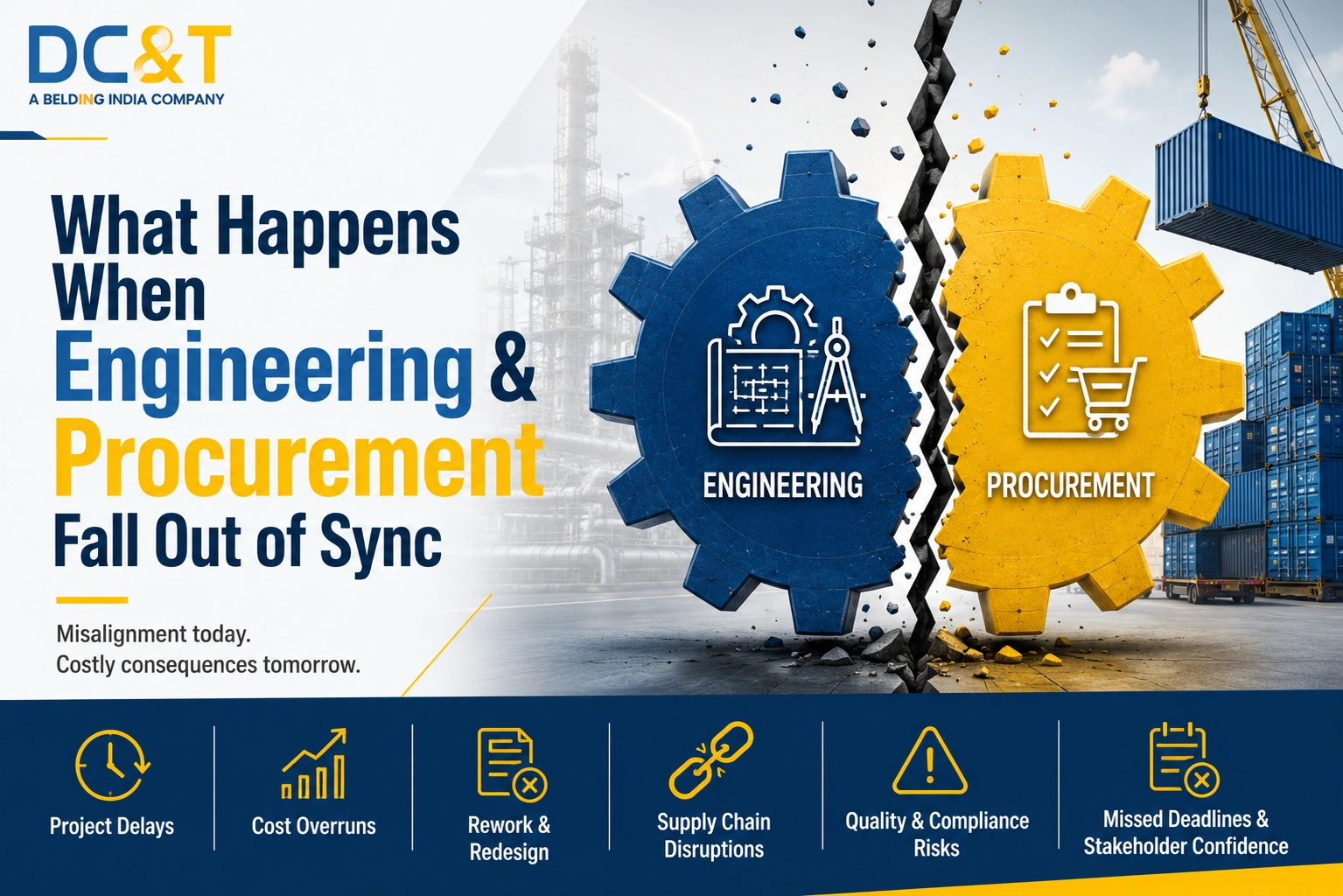
An engineering & procurement project can have a well-developed design and a capable procurement team, yet still lose time.
The problem may not be with either function individually.
It may be with the gap between them.
In engineering and procurement, Engineering defines what the project needs. Procurement determines how those requirements will be sourced, evaluated and brought to site. When these two functions move together, decisions made during design can support realistic procurement timelines, vendor availability and site execution.
When they fall out of sync, however, one decision can trigger several others.
A specification changes after procurement has started. A selected equipment supplier cannot meet the required delivery date. A long-lead item arrives after the site is ready for installation. Or equipment dimensions change after detailed design, affecting civil or electrical work.
The result is not simply a procurement problem.
It becomes a project execution problem.
Engineering and procurement are not separate stages
The traditional view of EPC can make engineering and procurement appear sequential.
First, engineering defines the requirements.
Then procurement purchases what has been designed.
In practice, complex projects rarely work that neatly.
Equipment availability can influence engineering decisions. Vendor capabilities can affect specifications. Lead times can influence construction sequencing. Procurement feedback can require design changes.
This means engineering and procurement need continuous interaction.
A specification that looks technically appropriate on paper may have limited supplier availability. A component that meets performance requirements may have a long manufacturing lead time. A preferred vendor may have technical limitations that need to be reflected in the design.
If these realities are discovered late, the project has fewer options.
The first consequence is often a design change
Consider a project where a critical piece of equipment is specified during engineering.
Procurement begins the vendor evaluation and discovers that the selected configuration has an extended lead time.
The project team now has choices.
Wait for the equipment and potentially affect the construction schedule.
Or identify an alternative.
But changing the equipment may not be as simple as changing the purchase order.
The alternative could have different dimensions, connection requirements, electrical characteristics, cooling requirements or installation conditions.
That can send the change back into engineering.
Drawings may need revision.
Other equipment may need coordination.
Civil provisions may change.
Electrical layouts may need adjustment.
A procurement issue has now become an engineering issue.
And the longer the change is discovered, the greater its impact can become.
Long-lead items can become schedule drivers
Not every item on a procurement list has the same importance.
Some materials can be sourced quickly. Others may require specialised manufacturing, testing, transportation or approvals.
These long-lead items can become critical to the project schedule.
The challenge is identifying them early enough.
If procurement is involved only after engineering is substantially complete, the project may discover too late that a critical item requires significantly more time than the construction sequence allows.
This is particularly important in projects involving specialised electrical equipment, power systems, cooling equipment, transformers, switchgear, battery systems and other engineered components.
The construction schedule may assume that equipment will be available at a particular stage.
Procurement has to make that assumption realistic.
Vendor selection can influence engineering
Procurement is also not simply about finding the lowest commercial price.
A supplier brings a particular technical configuration, manufacturing capability, testing process, documentation standard and delivery schedule.
Those factors can affect the project.
Suppose two suppliers can meet the broad performance requirement but use different configurations.
Their equipment may have different footprints, connection arrangements or auxiliary requirements.
Selecting one after the design has been finalised can therefore create additional coordination work.
This is why vendor engagement at the right stage of engineering can be valuable.
The purpose is not to let procurement dictate engineering.
It is to make engineering decisions with a clearer understanding of what the supply market can actually deliver.
Procurement can expose gaps in engineering
The relationship also works in the opposite direction.
Procurement can sometimes reveal that an engineering requirement is incomplete or ambiguous.
A specification may define performance but not provide enough detail for vendors to quote consistently.
Different suppliers may interpret the requirement differently.
The resulting bids become difficult to compare.
The procurement team then has to return to engineering for clarification.
This creates another cycle.
Clarification takes time.
Time affects procurement.
Procurement affects the project schedule.
The issue may look small at the beginning, but repeated clarification cycles across multiple packages can create significant project friction.
Good engineering therefore needs to be procurement-ready, not simply technically complete.
Procurement decisions can affect site execution
The consequences do not stop at engineering and procurement.
They eventually reach the site.
Equipment dimensions, delivery sequence, packaging, installation requirements and access conditions can all influence construction planning.
If equipment arrives in a different configuration from what the site team expected, installation may require additional work.
If equipment arrives late, the planned installation sequence may have to change.
If several interconnected systems are procured according to different timelines, one incomplete package can prevent another completed package from being commissioned.
This is where EPC integration becomes particularly important.
A procurement decision made weeks earlier can determine what the construction team can do today.
The cost is more than the purchase price
When engineering and procurement fall out of sync, the obvious concern is cost.
But the impact can extend well beyond procurement price.
A late design change may lead to rework.
An alternative supplier may have a higher cost.
A delayed delivery can affect manpower planning.
Site teams may need to be retained longer.
Installation sequences may need to change.
Expedited transportation may become necessary.
And if one delayed package affects commissioning, the impact can extend further into the project schedule.
This is why looking at procurement purely through purchase price can be misleading.
The relevant question is often:
What will this procurement decision mean for the project as a whole?
The solution is not simply “better coordination”
“Better coordination” sounds straightforward, but in a complex EPC project it needs to translate into specific practices.
Identify long-lead items early
Critical equipment should be identified during the early stages of project planning rather than after the entire design is frozen.
This gives the procurement team time to assess suppliers, manufacturing timelines and potential alternatives.
Bring procurement insight into engineering
Engineering teams benefit from understanding supplier availability, standard equipment configurations and realistic lead times.
This does not mean compromising technical requirements.
It means designing with the actual supply environment in view.
Establish clear technical specifications
Procurement cannot effectively evaluate suppliers when requirements are incomplete or open to multiple interpretations.
Specifications need to provide enough technical clarity for meaningful vendor comparison.
Manage vendor data as part of engineering
Vendor drawings and technical submissions are not merely procurement documents.
They can contain information that affects detailed engineering and site execution.
Reviewing that information early can prevent downstream changes.
Link procurement schedules to construction schedules
A procurement schedule should not exist independently of the project schedule.
Equipment availability needs to correspond with the point at which that equipment is actually required on site.
Otherwise, the project can end up with either idle equipment or an installation team waiting for equipment to arrive.
The real measure is whether decisions flow
The strongest EPC projects are not necessarily those where engineering and procurement never encounter a problem.
Changes are inevitable.
Specifications evolve. Suppliers change. Equipment availability shifts. Project requirements develop.
The difference is how early those changes are identified and how effectively information moves between functions.
When engineering knows what procurement is finding in the market, design decisions can account for supply realities.
When procurement understands why a specification exists, commercial decisions are less likely to compromise the project’s technical intent.
When construction knows what is being procured and when it will arrive, site planning becomes more predictable.
That creates a connected decision chain:
Engineering → Procurement → Construction → Commissioning
But the arrows should work in both directions.
From functional handoffs to integrated execution
The biggest lesson is that engineering and procurement should not be treated as two departments completing separate tasks.
They are two parts of the same project decision-making process.
Engineering defines the technical solution.
Procurement tests that solution against the realities of the supply market.
Engineering incorporates relevant vendor information.
Procurement converts the requirements into executable purchasing packages.
Construction then receives equipment that is aligned with both the design and the installation plan.
When this loop works well, problems are identified earlier — when they are still decisions rather than disruptions.
That is the real value of integration in EPC.
How DC&T Global approaches the connection
For DC&T Global, EPC is built around the relationship between engineering, procurement and execution rather than treating them as independent stages.
The objective is to carry project requirements through the entire delivery chain — from understanding the application and developing the engineering solution to sourcing the required systems and coordinating their execution on site.
This becomes particularly important in complex infrastructure projects where electrical systems, data center infrastructure, renewable energy, BESS and industrial requirements can involve multiple equipment packages and interdependent activities.
The closer engineering and procurement remain throughout the project, the easier it becomes to identify conflicts early, evaluate practical alternatives and keep procurement decisions aligned with the eventual execution plan.
The project does not experience departments
A project does not experience engineering, procurement and construction as separate functions.
It experiences their combined outcome.
If engineering and procurement fall out of sync, the consequences eventually appear somewhere else — in the schedule, on the site, in the budget or during commissioning.
That is why the objective should not simply be to make engineering efficient and procurement efficient individually.
It should be to make the connection between them efficient.
Because in EPC, the biggest delays are not always created by a function working poorly.
Sometimes, they are created by two functions working well — but no longer working together.
FAQs
- Why is alignment between engineering and procurement important in EPC projects?
Engineering defines technical requirements while procurement works within supplier availability, lead times, and commercial constraints. When these functions stay aligned, technical decisions are more practical, procurement risks are identified earlier, and downstream construction disruptions can be reduced. - How can procurement issues affect engineering decisions?
Procurement may discover limited supplier availability, extended lead times or technical constraints after specifications are developed. These findings can require engineering revisions, affecting drawings, equipment selection, layouts and connected systems, particularly when changes are identified after design has progressed. - Why are long-lead items important in EPC projects?
Long-lead equipment can determine when critical construction and installation activities can begin. Identifying these items early allows engineering and procurement teams to evaluate suppliers, confirm realistic delivery schedules and align equipment availability with the project’s construction and commissioning sequence. - How does vendor selection influence EPC project execution?
Vendors can offer equipment with different configurations, dimensions, connection requirements, manufacturing timelines and installation conditions. Selecting suppliers without considering these factors can create downstream design changes or site constraints, making vendor evaluation an important part of coordinated EPC execution. - How can EPC teams keep engineering and procurement aligned?
Alignment requires early identification of long-lead equipment, clear technical specifications, timely vendor engagement, structured technical reviews and procurement schedules linked to construction requirements. Continuous information exchange allows teams to address changes earlier, before they become costly project disruptions.
Sources: